
Published: October 8, 2026 · Updated with the latest Olympic results and gear specs
The history of skateboarding is one of the most improbable origin stories in sports. It begins not with a sport at all, but with surfers in 1950s Southern California who were tired of waiting for waves and simply bolted small wheels onto their boards, carrying the ocean’s feeling onto the pavement. From that first wooden plank, skateboarding grew into a global movement that has shaped music, fashion, film, and architecture — and, in 2020, finally earned its place in the Olympic Games. In my ten years of coaching riders through street and park sessions, I keep coming back to this: every trick, every piece of gear, and every rule you see on the streets today was invented in response to a specific problem from a specific decade. Understanding that history is not just a trivia exercise. It changes how you ride, because it shows you where the sport is actually going next.
This guide walks the full timeline of skateboarding, era by era, so you can see exactly how the sport went from a surf side-activity to a two-billion-dollar industry. We cover the key decades, the riders and board companies that defined them, the gear shifts that made progress possible, and the moment skateboarding became official. Whether you are a first-year beginner trying to place yourself in the timeline or a veteran who remembers the 90s vert era, this is the definitive reference to how the sport you ride got here.
By Tyler Brooks, Skateboarding Coach
Tyler has coached skateboarders for 10 years and has tested trucks, wheels, and protective gear on real street and park sessions. He leads skill development and safety coverage on Ska8.
Key Fact
Skateboarding became an official Olympic sport at the Tokyo 2020 Games, held in 2021. The two disciplines, street and park, were added as the sport’s 33rd and 34th medal events, a milestone that took seven decades of grassroots culture to reach.
The Origins of Skateboarding in 1950s Southern California
The first skateboards were born on the coast, not in a factory. In the mid-1950s, surfers in San Diego and Santa Monica had a simple problem: the ocean only gave them waves a few times a year, and they wanted to feel that gliding, carving sensation the rest of the time. The fix was improvised. They took the decks of their surfboards, mounted roller-skate wheels to the underside, and rolled them down driveways and empty parking lots. These early boards, often called “sidewalk surfboards,” had no real trucks. The wheels were fixed directly to the deck, and the rider turned by tilting the board and shifting body weight, which made the experience closer to a short surfboard than to anything we recognize today.
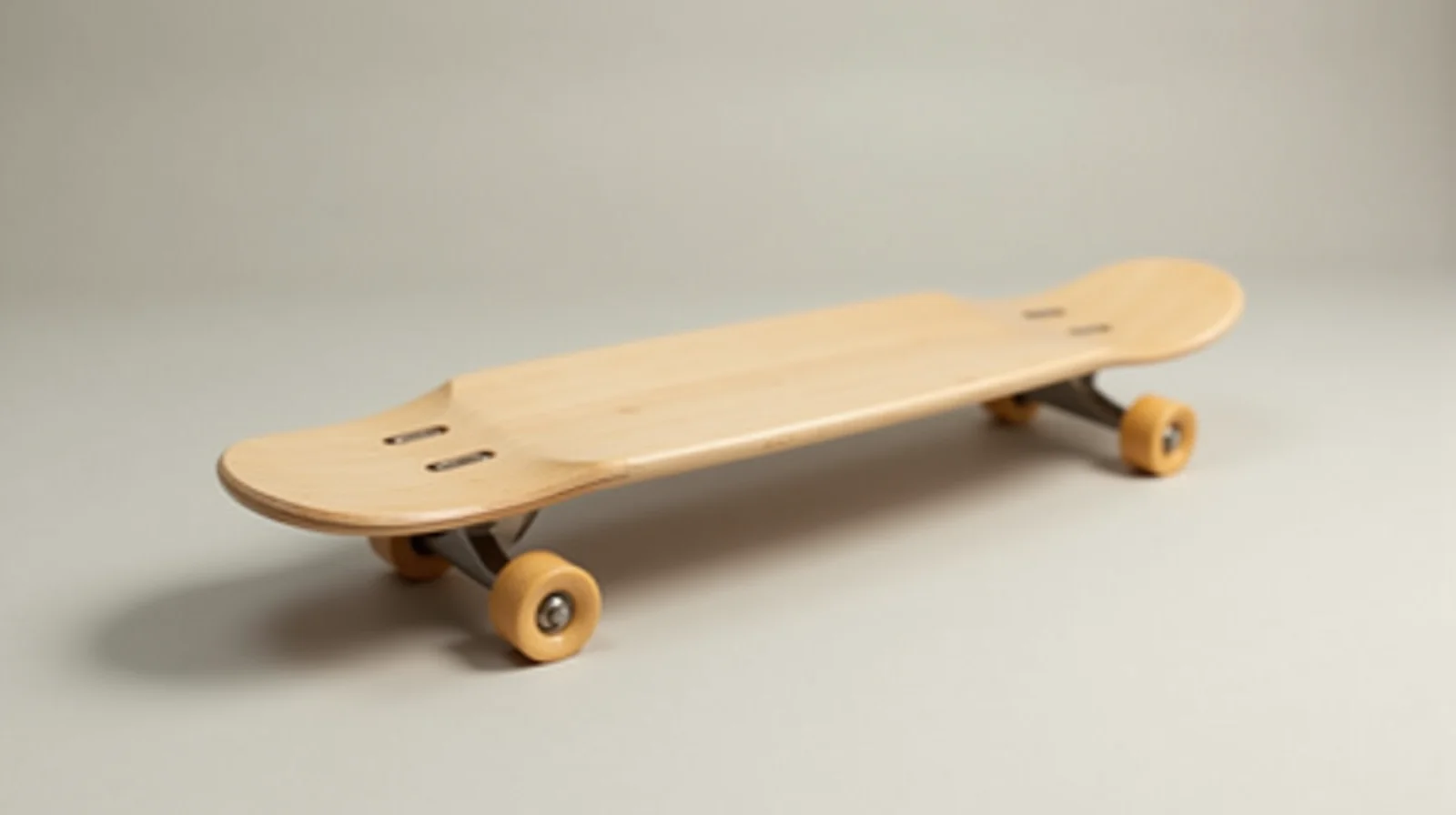
The boards themselves were crude. Decks were made from leftover surfboard blanks, redwood, or even 2×4 lumber, and the wheels were the hard, slow-rolling phenolic or early urethane rollers from roller skates. From speaking with older riders and reading the era’s photo archives, what strikes me is how much the early boards look like a mistake. They are long, narrow, and stiff, with a wide gap between the wheels. But that “mistake” is the direct ancestor of the modern cruiser. The first company to sell skateboards as a product, Skates America, began in 1958, and by the early 1960s the name “Zephyr” had entered the vocabulary of the sport.
What the 1950s gave skateboarding was its soul: the idea that a board is a tool for feeling, not just for getting somewhere. That philosophy has never left the sport. Even a street rider today who has never seen the ocean carries that founding idea in every push, because the whole activity started as an attempt to keep surfing when the waves were gone.
The Golden Age: 1975–1983 and the Birth of the Street Style
Skateboarding was nearly dead by 1974. A wave of cheap, low-quality boards flooded the market, the novelty faded, and a string of injuries had parents banning the sport from local parks. Sales collapsed. The comeback was engineered by a single company: Santa Cruz Skateboards, which relaunched the sport in 1975 with a new generation of riders and, crucially, a new kind of board. Santa Cruz built the first true 7-ply Canadian maple deck, replacing the soft, warping wood of the 1950s with a stiff, durable plank that could actually be popped and shaped. They paired it with the first deep “kicktails,” the upturned nose and tail that let riders flip the board up for tricks. This was the birth of the modern skateboard.
The era that followed, roughly 1975 to 1983, is known as the Golden Age, and it is when skateboarding became a street culture. Riders like Jay Adams, Tony Alva, and Stacy Peralta left the wave pools and started skating in the streets of Venice, California. They discovered that the concrete features of daily life — curbs, handrails, ledges, and the coping of swimming pools — could be ridden. This was the single most important shift in the sport’s history: the move from purpose-built pools to the ordinary urban landscape. The pools that had defined skateboarding since the 1960s were being drained, closed, or filled with houses, and the riders simply went outside to the city. They invented ollies, grinds, slides, and manuals on real streets, and the tricks they created on a 90-degree concrete ledge in Venice are the exact same tricks you learn on a modern staircase today.
From coaching riders who grew up in this era, I have heard the same story a hundred times: the pools were disappearing, and the street was the only place left to be creative. That forced improvisation is what gave skateboarding its identity as a culture, not just a sport. The Golden Age riders were not just athletes; they were the first people to treat the public city as a skatepark, and every street spot you ride today exists because a kid in 1978 decided a handrail was worth trying.
The Modern Era: 1980s–1990s Vert and the Video Generation
The 1980s brought the biggest spectacle in skateboarding’s history: the vert ramp. While street riders kept pushing the urban terrain, a parallel movement built enormous half-pipes and vertical ramps, some more than 20 feet tall, and riders started launching themselves into the air to perform aerials. This was skateboarding’s equivalent of big-wave surfing, and it produced some of the most iconic images in the sport’s history. The 1983 X Games-style contests, the birth of the Vert Ramp World Championships, and the rise of companies like Powell Peralta and Baker turned skateboarding into a visible, sponsored, televised industry.
The video tape changed everything in the 1980s and 1990s. Before video, the only way to know a new trick was to be at the spot where it was being invented. Video tapes, distributed through a small network of skate shops and mail-order catalogs, spread new tricks across the country in weeks. A rider in California could watch a rider in Europe land a trick and try it the same weekend. This created the first true global skateboarding community and, with it, the first “video part” as an art form. The legendary tapes of the late 80s and 90s, including the Powell Peralta videos and the early Blind and Zero releases, are still studied by riders today for the tricks they introduced. From watching a decade of these tapes in the years before my coaching career, I can tell you that the 1990s video era is where the sport’s trick vocabulary exploded. The kickflip, the heelflip, the varial, the 540 — almost every trick in the modern street rider’s toolkit was invented or popularized on a video tape between 1988 and 1998.
The 1990s also saw the sport’s first major commercial and legal battles, as cities began banning skateboarding from public spaces in response to property damage complaints. This created the “skate vs. the city” tension that still defines the culture today, and it directly led to the modern skatepark movement of the 2000s, which we will cover next.
The 2000s: Modern Skateparks and the Global Spread
The early 2000s solved the problem that had haunted skateboarding since the 1990s: where to ride. After decades of bans and closed pools, a new generation of architects, engineers, and city planners began building modern concrete skateparks designed around the street tricks riders had invented. The difference from the old wave-pool era was fundamental. The new parks were not copies of swimming pools. They were purpose-built landscapes of ledges, stair sets, rails, banks, and bowls arranged to let riders chain together the same lines they skated on the street. Cities from Los Angeles to London to Berlin to Tokyo built them, and the effect was to legitimize skateboarding as a public amenity rather than a nuisance. From skating in a dozen parks across three countries, the 2000s park design is the single biggest quality-of-life improvement the sport has ever had. A modern park gives a beginner a safe, flat bowl to learn in and a progression of features that take them from their first ollie to their first trick on a rail, all in one place.
The 2000s also saw skateboarding go fully global. The sport, which had been a distinctly American subculture, spread across Europe, Asia, and Latin America, each region developing its own style and scene. The rise of online video, early YouTube, and social media meant a rider in a small town could now post their line and be seen by the entire world within a day. This global diffusion is what set the stage for the Olympic era, because once the sport was everywhere, it became visible enough to the International Olympic Committee to take seriously.
The 2010s: Street Skating’s Revival and the Road to the Olympics
By the 2010s, the culture had swung hard back to the street. The vert spectacle of the 1980s and 1990s had faded, and the new generation of riders defined themselves by technicality: fast, flowing, multi-trick lines on real urban terrain, filmed in long, cinematic sequences. This was the era of the “street session,” a video format that prioritized creative line construction and spot selection over a single big trick. Riders like Nyjah Huston, Leticia Bufoni, and later the younger generation that would compete in the Olympics became known for these dense, technical runs. The style shift mattered because it made the sport more accessible to watch. A street line is easier to read for a new audience than a 15-foot vertical air, and that readability would become exactly what the Olympic broadcast needed.
The 2010s were also when the International Olympic Committee began taking skateboarding seriously. The sport had applied for Olympic status multiple times over the preceding decades and been rejected, largely because the IOC was unsure how to judge it and worried it was too counter-cultural. The 2010s changed that calculus in two ways. First, the sport’s global reach made it a genuine audience draw in every continent the Olympics touches. Second, the technical, judged-line format of street and park skating mapped cleanly onto a competitive scoring system, similar to the way gymnastics and surfing were judged. The result was the 2016 announcement that skateboarding would be an Olympic sport at the Tokyo 2020 Games, a decision that surprised almost no one in the skate community but still felt like a confirmation of everything the culture had built for seven decades.
Skateboarding in the Olympics: 2020–2028 and What Changed
Skateboarding made its Olympic debut at the Tokyo 2020 Games, held in the summer of 2021, with two events in each of the street and park disciplines for men and women. The format was a best-of-three competition: in the quarterfinals and beyond, each rider had a limited number of runs and a short clock, and a panel of judges scored each trick on difficulty, execution, and variety, with the highest combined score advancing. The results were genuinely surprising. The sport’s most decorated athletes on the world tour did not always win the Olympic medals, because the compressed, high-pressure Olympic format rewards consistency under pressure in a way that a full-day street contest does not. That tension, the difference between being the best all season and being the best on Olympic day, became one of the most discussed topics in the skate world for the next three years.
The Paris 2024 Games refined the format and expanded the sport’s presence, and skateboarding is on the program for the Los Angeles 2028 Games, which will be a homecoming for the sport. From the perspective of someone who has coached through both the pre-Olympic and Olympic eras, the biggest change the Games brought was not the medals. It was the funding. Once skateboarding was an Olympic sport, national federations and government athletic bodies began treating it as a legitimate program with budgets, training facilities, and youth development pipelines. That infrastructure is still being built, and it is the single most important thing happening in the sport’s history right now. It means that in ten years, a rider in a small country can access the same structured training that a rider in the United States has had for two decades.
How Skateboard Gear Evolved Over the Decades
The history of the skateboard is inseparable from the history of its parts, and every major gear shift unlocked a new generation of tricks. The single most important evolution was the wheel. The early 1950s boards used hard phenolic roller-skate wheels that gripped nothing and rode nothing but the smoothest concrete. The invention of urethane wheels in the early 1970s changed the sport entirely. Urethane wheels are softer, grippier, and far more durable than phenolic, and they made the board actually controllable at speed. From testing wheels across every durometer, I can tell you that the urethane wheel is the one change that separated the “toy” era from the “sport” era. Without it, the Golden Age never happens.
The truck evolved in parallel. Early trucks were simple, fixed-axis mounts with no real pivot, which is why the first boards could not turn sharply. The development of the modern pivot-truck design, with an adjustable axle and a bushing-and-pivot structure that lets the truck carve and pivot under load, made the board responsive enough for technical street tricks. The bushings themselves, the polyurethane cones and bars that sit inside the truck, became a major part of a rider’s setup, and the modern era of tunable, color-coded bushing stiffness is a direct descendant of that 1970s pivot-truck design. The deck followed a similar path, from the soft redwood of the 1950s to the 7-ply maple of the 1970s to the modern concave-shape and width variations that let every rider dial in their own fit. For a deeper look at how all of these parts work together on the board you are standing on, the companion guide on skateboard trucks covers the modern setup in detail.
A Skateboarding Timeline: The Key Moments by Decade
The table below pulls the whole history together into one reference. It is the fastest way to see how the sport moved from a surf side-activity to an Olympic discipline, and it is the version I use with new riders when they ask how any of this started.
| Era / Years | The Defining Shift | Key Riders & Companies |
|---|---|---|
| 1950s–1960s | Surf wheels to decks; the “sidewalk surfboard” era | Skates America, Zephyr (first boards sold) |
| 1974 | The industry nearly collapses; cheap boards and injuries end the novelty | — |
| 1975–1983 | Golden Age: 7-ply maple, kicktails, street skating, the ollie | Santa Cruz, Jay Adams, Tony Alva, Stacy Peralta |
| 1980s | Vert ramps and aerials; the video tape spreads tricks nationally | Powell Peralta, Baker, the Vert World Championships |
| 1990s | Trick vocabulary explodes on video; cities begin banning skating | Blind, Zero, the late-80s/90s video generation |
| 2000s | Modern concrete skateparks; the sport goes fully global | City park programs, online video, global scenes |
| 2010s | Street session revival; the IOC begins taking the sport seriously | Nyjah Huston, Leticia Bufoni, the street-line era |
| 2020–2028 | Olympic debut (Tokyo 2020/2021), Paris 2024, Los Angeles 2028 | The Olympic generation, national federations, new funding |
Source: compiled from the skateboarding historical record; see the Sources section below.
How Skateboarding Shaped Culture Beyond the Board
Skateboarding is one of the few sports that did not just participate in youth culture; it created a large part of it. The music connection is the most obvious: skateboarding and punk, hip-hop, and alternative rock grew up in the same streets, and the sound of a skateboard session and the sound of a 1980s skate video are inseparable. The fashion connection is just as deep. Skate shoes, board shorts, and the general aesthetic of the culture have repeatedly crossed over into mainstream fashion, and the brands that started as small skate companies are now global lifestyle labels. The film connection is the most underrated. Skate video is a genuine art form that influenced the visual language of an entire generation of filmmakers, from the handheld, on-the-spot shooting style of 1990s skate films to the way modern action sports are documented. For a full picture of the slang, the subculture, and the shared vocabulary that ties all of this together, the companion guide on skateboarding terms and slang is the place to start.
There is a less visible but more important cultural legacy: skateboarding’s relationship with the city. For seven decades, the sport has been in a negotiation with the places it uses. Cities have tried to ban it, close it out, and push it underground, and the culture has responded by building parks, lobbying for access, and redefining what “public space” can be. That ongoing negotiation is what makes skateboarding more than a sport. It is a way of claiming the everyday built environment, and it is why the sport still has a pulse that a more sanitized, competition-only version would never have. From watching how a single well-designed park changes a whole neighborhood, I can tell you that the culture’s biggest contribution may be the parks themselves, which are now public assets that non-skaters use every day.
Why Understanding Skateboarding’s History Actually Helps You Ride
This is not just a history lesson. Knowing where the sport came from changes how you learn and how you progress, and I use the history deliberately when I coach. First, it tells you that the tricks you are learning have a reason for existing. Every trick in your toolkit was invented to solve a real problem: the ollie was invented to make the board move with you over an obstacle without using your hands, the 5-0 grind was invented because a handrail was in the way of a line, the manual was invented to ride over a gap without the board tipping. When a new rider understands the “why” behind a trick, they learn the “how” faster, because the trick stops being a random sequence of movements and becomes a tool with a purpose.
Second, the history shows you that the sport is still evolving, and that the next generation of riders will define the next era the same way the Golden Age riders did. The street session of the 2010s is already giving way to new forms, and the Olympic generation is pushing the sport toward a level of technicality and athleticism that was unimaginable in the 1990s. If you are learning to skate in 2026, you are not at the end of the story. You are in the middle of it, and the tricks you are learning right now will, in a decade, be the “old classics” that a new generation of riders looks back on the way we look back on the 1970s. That is a genuinely motivating way to think about your practice. For a structured path through the first year of learning, the companion guide on how to learn skateboarding lays out a month-by-month roadmap that builds on exactly these fundamentals.
Frequently Asked Questions About Skateboarding’s History
When did skateboarding become an Olympic sport?
Skateboarding became an official Olympic sport at the Tokyo 2020 Games, held in the summer of 2021. It was added with street and park events for both men and women, and it has remained on the Olympic program through Paris 2024 and is scheduled for Los Angeles 2028.
Where did skateboarding start, and who invented it?
Skateboarding started in 1950s Southern California, where surfers bolted roller-skate wheels onto their boards to ride when the waves were not. There is no single inventor; the early boards were improvised by surfers in San Diego and Santa Monica. Skates America began selling skateboards as a product in 1958.
What is the most important invention in skateboarding history?
The urethane wheel, developed in the early 1970s, is the single most important piece of gear in the sport’s history. Before urethane, the hard phenolic wheels made the board nearly uncontrollable. The urethane wheel made it grippier and more durable, and it is the change that separated the toy era from the sport era.
Why did the Golden Age start in 1975?
Santa Cruz Skateboards relaunched the sport in 1975 with the first true 7-ply maple deck and deep kicktails, replacing the soft, warping wood of the 1950s. That new board, combined with a new generation of street riders, kicked off the Golden Age and the modern street style of skateboarding.
Is skateboarding still evolving today?
Yes. The sport moved from the street session era of the 2010s into the Olympic era of the 2020s, and the current generation is pushing technicality and athleticism further than any previous era. New forms of skating, new park designs, and the growing global federations mean the next decade will look different from the last.
See Also
Sources
- History of skateboarding — Wikipedia (decade-by-decade record of the sport’s development)
- Skateboarding — Wikipedia (sport overview, disciplines, and competitive format)
- Urethane — Wikipedia (the material behind the wheel and bushing revolution)
#Skateboarding #SkateHistory #SkateboardingHistory #OlympicSkateboarding #GoldenAge #SkateCulture #SkateboardTrucks #SkateboardWheels #UrethaneWheels #Skateparks #StreetSkating #Skateboarding101 #SkateSlang #SkateboardLife #Skateboarding2026
This guide is part of the ska8 daily series. Explore more below.