Every time you drop into a local spot and hear a skater shout send it, ask you to duck a gap, or call a setup range, the language hits before the trick does. Skateboarding terms are not just jargon — they are a compressed way skaters use to describe a board, a line, a fall, and a whole culture in a single word. If you are new to the sport, that wall of lingo is one of the fastest ways to feel like an outsider at a session.
By Tyler Brooks, Skateboarding Coach
Tyler has coached skateboarders for 10 years and has tested trucks, wheels, and protective gear on real street and park sessions.
Published: September 11, 2026
From ten years of coaching beginners through their first flatground ollie and their first real street session, I have seen the same pattern repeat. A new skater can pick up the physical mechanics of a trick in an afternoon, but the language is what makes them belong. When you can follow a conversation at a bowl, read a setup thread, or understand what a friend means when they say this line is too range, you stop being a tourist and start being part of the scene.
This guide is the glossary I wish had existed when I started. It covers the full vocabulary of skateboarding in 2026 — board anatomy, stance and riding terms, every major trick family, street slang, park and bowl language, and setup terminology — with plain-English definitions and the context you actually need. It is organized so you can read it top to bottom or jump straight to the term that is confusing you right now.
Why Skateboarding Has Its Own Language
Skateboarding grew up in the 1950s and 1960s as a blend of surfing, roller skating, and street culture, and it absorbed the compact, code-like language of each. Surf gave the sport its wave-reading vocabulary; the street gave it the blunt, physical honesty of calling a failed attempt a bail the second it happens. Because skateboarding is built on repetition — you fall, you reset, you try again — skaters developed a shorthand to describe setups, attempts, and results in one or two words instead of a full sentence.
That shorthand is why the same word can mean slightly different things in different regions. A range is a gap or a distance you clear; a line is a connected sequence of spots; flow is how smoothly one trick leads into the next. None of these terms are written down in one official dictionary, so this glossary standardizes the definitions the way they are used most commonly on the street and in the parks in 2026. If your local scene uses a term differently, trust the local usage — but the definitions below are the baseline you will meet everywhere.
Skateboard Anatomy: The Parts and Their Names
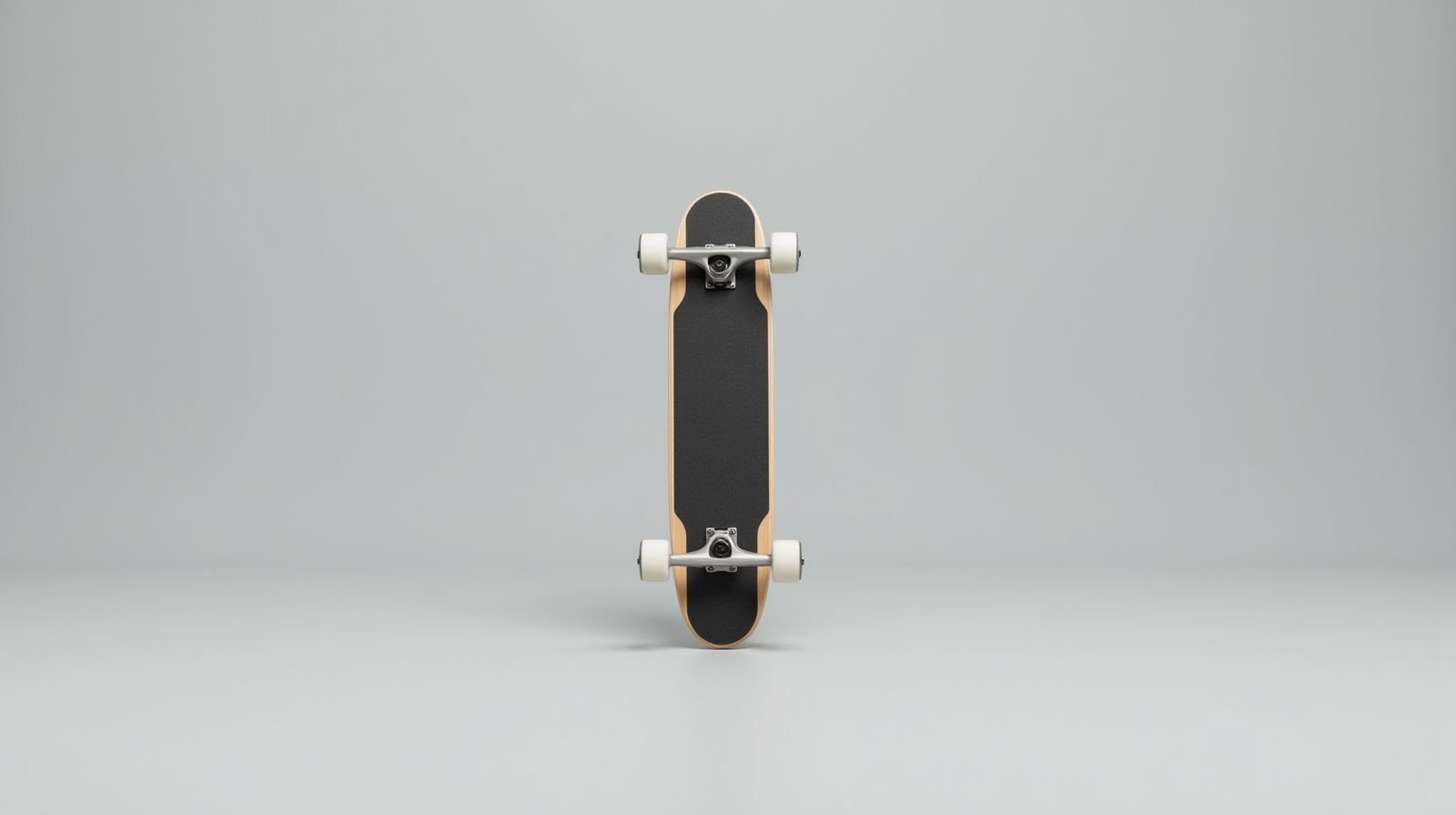
Most new-skater confusion starts at the board itself, because people say the truck when they mean the hanger, or the axle when they mean the whole assembly. Here is the standard breakdown of a street board in 2026, the function of each part, and the exact term you will hear skaters use. If you are building your first setup, our guide on how to choose your first skateboard walks through each of these choices.
| Part | What It Does | Term You Will Hear |
|---|---|---|
| Deck | The maple board you stand on; pop and concave come from here. | Board, deck |
| Trucks | The metal assembly that connects deck to wheels and lets you turn. | Trucks (the whole thing) |
| Kingpin | The bolt on the front of the truck that sets turning and tightness. | Kingpin, baseplate bolt |
| Bushings | The urethane pads that resist turning and control how the board carves. | Bushings (soft / hard) |
| Hanger | The part of the truck the axle mounts to; its length is the truck width. | Hanger, axle |
| Wheels | The rolling element; size, durometer, and profile change the feel. | Wheels, size / durometer |
| Bearings | The steel rings inside the wheels that let them spin; rated by ABEC. | Bearings, ABEC rating |
| Grip tape | The sandpaper sheet on top of the deck that keeps your feet planted. | Grip, grip tape |
| Hardware | The nuts and bolts that clamp the trucks to the deck. | Hardware, bolts |
Reference: standard 8-piece street setup as assembled in 2026 retail and pro setups.
Coach note
The single most common mistake I see is a beginner calling the whole metal assembly a “hanger” or a “kingpin.” The truck is the complete unit. The hanger is the piece that swings; the kingpin is the bolt that holds it. Get those three words straight and half of every setup conversation makes sense.
Stance and Basic Riding Terms
Before any trick, there is the way you stand and move. These terms describe your default position and the basic motions that everything else is built on. If you are not sure which stance you are, stand up straight with your feet shoulder-width apart: whichever foot you naturally step forward with is your front foot, and that determines your stance.
Regular and goofy. If your left foot is forward you ride regular; if your right foot is forward you ride goofy. Roughly six in ten skaters are regular. Neither is better — it is simply which foot leads. A switch stance is riding with your feet reversed from your normal stance, which is far harder and shows up as a modifier on almost every advanced trick (switch ollie, switch kickflip).
Fakie. Riding fakie means rolling backward, tail-first, facing the opposite direction from the way you are traveling. You are still pushing and turning, but your back is to the direction of motion. Everything can be done fakie, and once a trick lands while you are rolling fakie it is usually just called fakie plus the trick name.
Push and carve. The push is the fundamental way a skateboard gains speed — you kick the trailing foot against the ground in short strokes. A carve is a smooth, S-shaped turn where you shift your weight through the truck rather than popping or turning sharply. In a bowl or on transition, carving is how you maintain speed around the walls.
Manual and nose manual. A manual is balancing on the back two wheels while rolling, like a scooter wheelie. A nose manual is the opposite — balancing on the front two wheels. Both are balance tricks, not flip tricks, and they are the foundation for every balance-based trick in the sport. Our manual guide breaks down how to build the balance for both.
Pro tip
Learn the stance and riding terms out loud with a friend or by narrating your own session. Naming what you are doing (“that was a fakie push, now I am carving”) is what turns passive vocabulary into words you actually reach for on the street.
The Ollie Family and Jump Terms
The ollie is the center of gravity of the entire trick vocabulary. Invented in 1978 by Alan “Ollie” Geller, it is the jump where you pop the tail down with your back foot and slide your front foot up the grip tape to bring the whole board into the air with you, without your hands. Every other air trick is an extension of the ollie, so the jump terms cluster around it.
Pop. The sharp downward snap of the tail that launches the board. “Pop it” is the universal cue to jump. How much pop you have — and how clean it is — determines everything about your height and control.
Nollie. A nollie (short for “no-ollie,” but really a frontside ollie) pops the nose instead of the tail, so the board rotates the other way. A nollie ollie is the basic version; a nollie flip combines it with a flip. It is the mirror image of the ollie and one of the most useful tools in the modern trick set.
Grab. A grab is any trick where you catch the deck with a hand mid-air. There are a dozen named grabs (indy, melon, tailgrab, nosegrab) defined by which part of the board you catch and with which hand. Grabs are the link between street jumping and the big-air, vert, and slopestyle worlds.
Flip and varial. A flip rotates the board along its long axis (front to back); a varial (variable ollie) rotates it along its side-to-side axis. The difference between those two rotations is the single most important distinction in the whole trick vocabulary, because it separates the flip-trick family from the varial family. Master that one idea and you can read any trick name you have never seen.
The Flip-Trick Family: Names and What They Mean
The flip-trick family is where the vocabulary gets densest, and where most beginners feel lost. Once you understand the two rotation axes — long-axis flips and side-axis varials — the names become almost mechanical. Here are the core flip tricks and exactly what each word tells you about the board motion. Full step-by-step breakdowns live in our kickflip guide and heelflip guide.
| Trick | Board Motion | How to Read the Name |
|---|---|---|
| Kickflip | Board spins once along its long axis, toe-side up. | Kick the toe edge out; one 360 flip. |
| Heelflip | Board spins once along the long axis, heel-side up. | Mirror of the kickflip; flick the heel edge. |
| 360 flip (tre flip) | Board rotates a full 360 on both axes. | The whole board does one full spin; “tre” = three. |
| Shuv-it | Board slides 180 on the side axis, no pop flip. | Pure side rotation; the base of every varial. |
| Varial | Board rotates along the side axis while jumping. | “Variable ollie”; often combined with a flip. |
| Inward heelflip | Heelflip where the board rotates toward your body. | Direction modifier + flip name. |
| Nollie flip | Frontside pop combined with a flip. | Nollie axis + flip axis combined. |
Reference: standard long-axis vs side-axis rotation used across 2026 street and park trick sets.
Grinds, Slides and Rail Terms
When the board leaves the ground and its trucks or deck make contact with an edge — a rail, a ledge, a coping — you enter the grind and slide vocabulary. This is the family skaters talk about the most at flat spots. The full breakdown is in our grinds guide, with dedicated guides for the nosegrind and the tailslide.
Grind. A grind is any trick where a truck (or both) slides along the edge of an obstacle. The name of the grind tells you which truck and which part of the truck is in contact.
5-0 (five-zero). The back truck grinds the rail or ledge. It is the first grind most skaters learn because the back truck is the one you naturally drive into the obstacle with.
50-50 (fifty-fifty). Both trucks are in contact with the edge at the same time, the board riding flat along the rail. It is the grind version of the manual — a pure balance trick on a contact surface.
Nosegrind. The front truck grinds the obstacle, nose-first. It is the reverse of the 5-0 and the foundation of the front-truck grind family.
Boardslide. The board slides across the obstacle perpendicular to its length, the board deck itself making contact rather than a truck. A lipslide is a boardslide on the nose or tail; a feet-side or switch boardslide names which side faces you.
Tailslide and noseslide. A tailslide rides the tail flat along the obstacle with the board parallel to the edge; a noseslide does the same with the nose. These are the two cleanest slides and the ones that dominate modern street and flat lines.
How to read any grind or slide name
Almost every contact-trick name encodes three facts: which part of the board is in contact (nose, tail, truck, deck), the axis of the contact (along or across the obstacle), and any direction modifier (switch, fakie, feet-side). Once you parse those three slots, a name like “switch tailslide” or “feet-side lipslide” stops being a foreign phrase and becomes a description you can picture.
Street Slang: The Words Skaters Actually Say
This is the part of the language that never appears in a manual but is the fastest way to sound like you belong. These are the blunt, physical, one-word descriptors skaters use to judge a spot, a line, a trick, and each other. From a decade of coaching and street sessions, these are the ones you will hear constantly.
| Term | Meaning | Typical Usage |
|---|---|---|
| Duck | A gap, hole, or opening you skate through or over. | “There is a duck between those two curbs.” |
| Range | A distance or gap, often one that looks scary to clear. | “That gap is range; send it or bail.” |
| Bail | Falling or failing a trick; the attempt itself. | “I bailed that ledge three times.” |
| Send it | Committing fully to a big or risky attempt; a celebration. | “He sent it down the whole rail.” |
| Slip | The board sliding out from under you; a clean, controlled miss. | “Just slipped, no harm done.” |
| Cringe | An awkward or badly-executed attempt; a near-bail. | “That was a cringe, but he stuck the landing.” |
| Stuck | Successfully landing a trick, especially a hard one. | “He finally stuck the nollie heelflip.” |
| Clean | Landing with no touch, no wobble, no hesitation. | “That was a clean 50-50, no truck touch.” |
| Sketchy | A spot that is risky, unstable, or hard to land. | “That landing is sketchy, watch the gap.” |
| Flow | How smoothly a sequence of tricks connects into one line. | “That whole run had amazing flow.” |
Reference: colloquial street usage as observed across 2026 flat, street, and park sessions.
Lines, Spots and Session Language
Skaters talk about the world around them — the concrete, the obstacles, the places they skate — in a vocabulary of its own. These terms describe the physical environment and the act of skating it.
Line. A line is a connected sequence of tricks and obstacles you skate in one continuous run, from start to end without stopping. Skaters “read” a line before skating it, deciding which spots to hit and how to connect them. The quality of a line is judged by its flow, its difficulty, and how it uses the available obstacles.
Spot. A spot is a single skatable feature — a ledge, a rail, a curb, a bank. A session at a location is a series of spots worked in sequence. Skaters “find” new spots, which means discovering an unskated or underused feature at a familiar location.
Session. A session is a block of time spent skating, usually at one location with a group. “Let us go session” is the universal invitation. Session length and intensity vary wildly, but the word always means dedicated, focused skating time.
Flat, street, and vert. These are the three main disciplines. Flat skating is on level ground with obstacles; street skating is on urban infrastructure (stairs, rails, ledges, curbs); vert skating is on a half-pipe or vertical ramp. Each has a slightly different accent to the shared vocabulary, but the core terms transfer across all three.
Park. A park is a purpose-built skate park with designed bowls, ramps, and obstacles. Our skate parks guide covers how to read a park and find the right features for your level. A DIY spot is a feature skaters build or modify themselves, which is a whole sub-culture of the sport.
Setup and Gear Terms: How Skaters Talk About Their Boards
When two skaters compare setups, they do it in a compressed shorthand that mixes part names, measurements, and feel words. Learning this vocabulary is what lets you read a setup thread, understand a recommendation, or explain your own board to someone. Here are the terms that matter, and the references to dig deeper into each component — our deck guide, wheels guide, bushings guide, and bearings guide.
| Term | Meaning | Why It Matters |
|---|---|---|
| Width | Deck width in inches, typically 7.5 to 8.25. | Wider = stable; narrower = nimble for flips. |
| Concave | The curve of the deck; low, medium, or high. | Higher concave grips feet and helps pop. |
| Truck size | Hanger width (e.g. 8.125, 8.625). | Should roughly match deck width for balance. |
| Durometer | Wheel or bushing hardness on a scale (e.g. 99a). | Softer grips and absorbs; harder lasts and rolls. |
| ABEC rating | Bearing tolerance grade (5, 7, 9). | Higher = smoother, but seal and shield matter more. |
| Camber | How the deck curves edge to edge; a pop characteristic. | Affects how much the board snaps on pop. |
| Riser | A spacer that lifts wheels away from the deck. | Prevents wheelbite on big carves. |
Reference: standard setup dimensions and hardness ratings used in 2026 street and park builds.
Bowl, Ramp and Vert Terms
The vertical world — bowls, ramps, and vert — has its own accent on the shared vocabulary. If you skate transition, these are the terms that come up constantly. A bowl is a wide, pool-shaped depression; a ramp is a single inclined surface; a vert ramp is a quarter-pipe or half-pipe that goes fully vertical.
Transition. Transition is the curved surface where flat ground meets a wall, ramp, or bowl. All the curved skating in the parks is “transition skating,” and it is the discipline where speed, carving, and airs come together. The coping is the metal pipe at the top of any transition that you ride over to launch into the air.
Drop-in. The drop-in is the moment you let go and let gravity pull you down from the top of a ramp or bowl into the transition below. It is the signature move of vert and park skating and the first thing you learn to commit to when you get taller.
Lip and flat. The lip is the very top edge of a ramp or bowl, where the coping sits. The flat is the level ground at the bottom. Moving between the lip and the flat is the basic rhythm of transition skating, and “hitting the lip” means riding all the way to the top.
Air and stall. An air is any moment your board leaves the surface of a ramp or bowl. A stall is stopping on the lip, balancing at the very top before dropping back in. Stalls are a core vert skill and the foundation for bigger air tricks. A rocker is the motion of pushing off the lip on one side and landing on the other.
If you are new to the bowl
Learn these terms before you get tall. Knowing what a stall, a rocker, and a drop-in are before you attempt them is the difference between a controlled session and a panicked one. Start flat, learn the drop-in, then add the stall.
Safety and Injury Terms You Should Know
The safety vocabulary matters because it is how skaters communicate about risk — to each other and to the people watching. Knowing these terms helps you understand a warning before it becomes a bruise. Our essential safety gear guide and helmet fit guide cover the protective equipment behind these terms.
Wipeout. A wipeout is a full fall where you and the board separate, usually with some impact. It is the casual, non-dramatic word for a hard fall and the one skaters use to keep a fall from sounding as serious as it looks.
Waxing. Waxing means falling and sliding out on your back or side, often while the board rolls away. It is a specific kind of wipeout and the reason wrist guards exist.
Rip. A rip is a tear or laceration, usually on the forearm, knee, or hip from sliding on pavement. “He ripped his knee” is the standard way to report a cut that needs a bandage, not a clinic.
Gear up. Gear up means putting on protective equipment — helmet, wrist guards, knee pads, elbow pads — before skating. It is the responsible default for any session where you are learning new tricks or skating taller. The terms name the specific gear: helmet, wrist guard, knee pad, elbow pad, and grip socks.
Spotting. Spotting is when a friend stands ready to catch or break a fall as you attempt something new. It is a core part of how beginners learn safely, and asking someone to spot you is one of the smartest moves you can make when a trick is slightly above your level.
The safety bottom line
Most skate injuries are preventable and most of them are minor — a wipeout, a rip, a bruise — when you gear up and spot. The vocabulary here is not optional; it is how a session stays fun instead of ending in the ER. Learn the words, then learn to use the gear they describe.
Skateboarding Terms FAQ
Build Your Own Skateboarding Vocabulary
The fastest way to make these terms yours is to use them. At your next session, name what you are doing out loud — “fakie push, now I am carving into the transition, drop-in, stall.” Read a setup thread and match each part to the board in front of you. When a skater says a word you do not know, ask — the culture rewards curiosity far more than it penalizes a wrong guess. Within a few sessions the wall of lingo stops being a barrier and starts being a language you actually speak.
Skateboarding terms are the compressed memory of a sport that has been evolving for over sixty years, and every term in this glossary is a small story about how a trick, a fall, or a spot came to be named. Learn the words and you inherit that whole history at the same time. Drop in, gear up, and start skating the language.
See Also
- How to Choose Your First Skateboard — Complete Buyer’s Guide
- How to Ollie: Step-by-Step Guide for 2026
- Essential Safety Gear for Skateboarding — Beginner Guide
Sources
- Wikipedia — Skateboarding (history, terminology, and trick classifications)
- Skateboarder Magazine (trick and pro terminology from trade coverage)
- Berrics (trick database and step-by-step definitions)
#Skateboarding #SkateTerms #SkateSlang #SkateGlossary #Skateboarder #SkateLife #LearnSkateboarding #SkateTricks #Ollie #Kickflip #SkateCulture #SkateParks #Skateboarding101 #SkateVocabulary #Skateboarding2026
This guide is part of the ska8 daily series. Explore more below.