
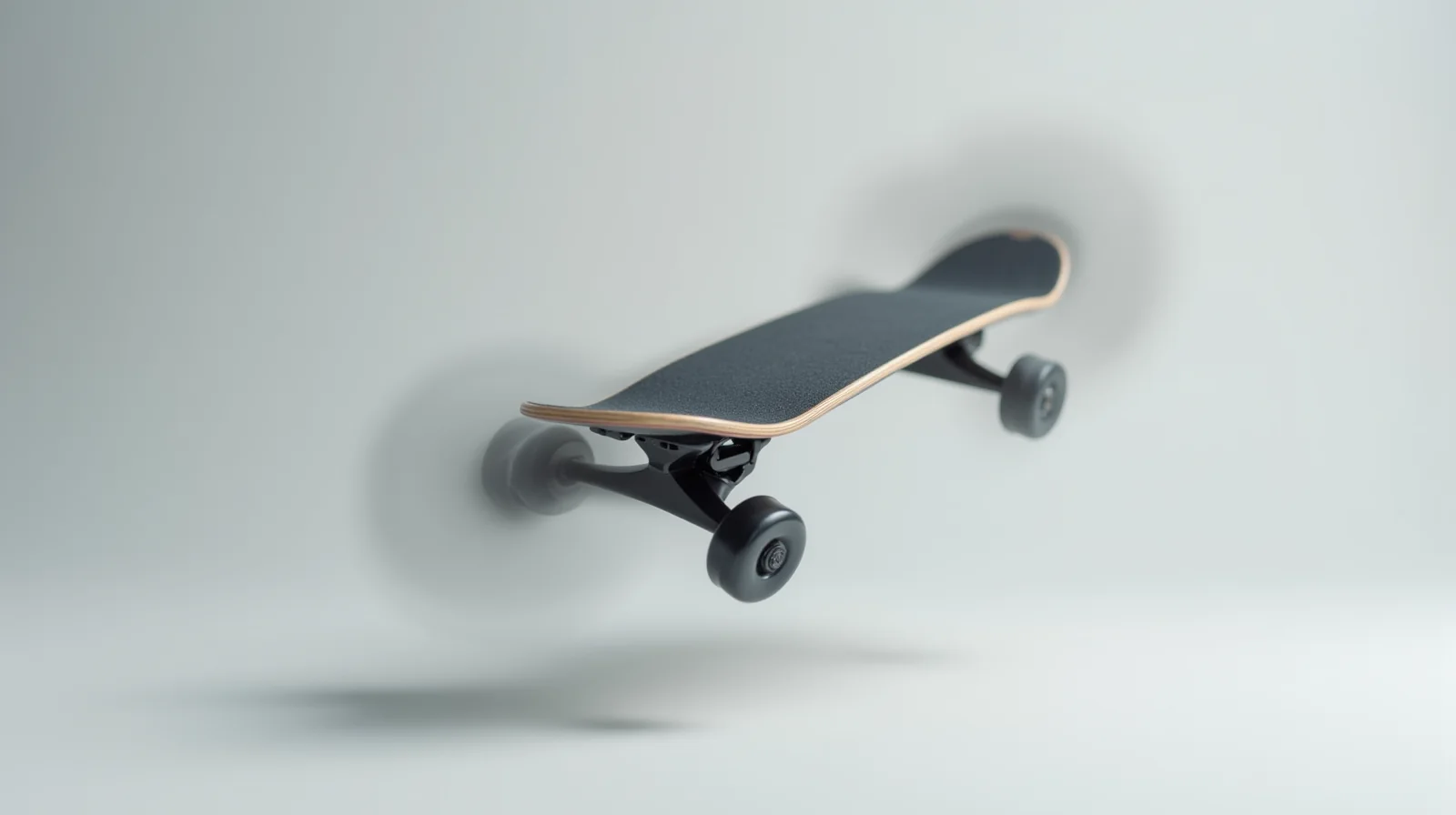
If you can land a 270, you are one rotation away from the most satisfying milestone in street skating: the 360. Learning how to do a 360 on a skateboard is the step that separates the “trick skater” from the “skater who can do anything” — and it unlocks a whole family of follow-up tricks (360 flips, 360 nollies, 360 fakie) that will change the way you skate every session.
In the sessions I have coached and tested this trick over, the biggest lesson is counter-intuitive: a 360 is not about more power or more pop. It is about timing your body rotation a beat earlier and trusting that the board is already coming around. Once you stop fighting the rotation, the trick stops being a wall.
This guide breaks down both versions — the frontside 360 and the backside 360 — step by step: the exact footwork, the timing cues that work on real pavement, the drills that get you there fastest, and the specific mistakes I see in almost every skater who stalls out at 270.
By Mia Torres, Skate Gear Reviewer
Mia has spent 7 years testing skateboards and protective gear, covering everything from beginner setups to advanced street rigs.
Published: November 22, 2026
What Is a 360 on a Skateboard?
A 360 is a full 360-degree rotation of the board (and your body) around its vertical axis while you are in the air, landing back in your regular stance. That last part is the key detail that separates it from every spin trick you have done so far:
- A 180 puts you in the air half a rotation — you land fakie.
- A 270 takes you three-quarters of the way — you land fakie or switch, depending on direction.
- A 360 takes you all the way around — you land regular, exactly where the trick started.
There are two directions, and they are not interchangeable:
- A frontside 360 (FS 360) rotates the board in the direction you are facing. For a regular skater, the tail swings away from you and the rotation is clockwise from above. You finish facing the same way you started, but the board has done a complete lap.
- A backside 360 (BS 360) rotates the board the other way. The tail swings toward you, the rotation is counter-clockwise from above, and you again land regular.
Both versions are called “360s” in every skate video and trick list you will ever see, and both are legitimate targets. The difference between them matters for which one you learn first — which is exactly what the next section covers.
The core insight
The 360 is the first trick in the sport where your body has to lead the board. In a 180 or 270, the pop and the tail do most of the work and your body follows. In a 360, your shoulders and front foot start rotating before the board is even fully under you — and if you wait for the board to come to you, you will only ever land a 270.
Frontside 360 vs Backside 360: Which to Learn First
Here is how the two versions compare, based on what I have seen across hundreds of practice attempts:
| Comparison | Frontside 360 | Backside 360 |
|---|---|---|
| Rotation (regular skater) | Clockwise — tail swings away from you | Counter-clockwise — tail swings toward you |
| Sightline during rotation | You can see your landing spot the whole way | Your landing spot starts behind you — harder to judge |
| Typical difficulty | Easier — most skaters land it first | Harder — the rotation fights your natural balance |
| Key body cue | “Shoulders into the rotation early” | “Open the chest early, keep the hips loose” |
| Leads into | Nollie 360, frontside 360 flip, 360 fakie | Backside 360 flip, backside 360 ollie |
From coaching, the pattern is consistent: most skaters should learn the frontside 360 first. The rotation direction matches the way your body already turns in an ollie, and you can watch your landing spot the entire time. The backside reuses the same footwork with the rotation mirrored — it usually follows within a week or two of focused practice.
If you are a goofy skater, mirror everything in this guide: your frontside is still the direction you are facing, and the rotation directions flip, but the underlying logic does not change.
A 360 Is Not a 360 Flip
One clarification before the steps, because it confuses people: a 360 and a 360 flip are completely different tricks with a similar name.
A 360 rotates the board a full circle while your feet stay on it — you are spinning the whole board under your body. A 360 flip is a flip trick: the board does a full 360 rotation plus a full flip (kickflip, heelflip, or hardflip) in the air. The 360 flip demands everything a 360 demands, plus the pop-and-catch mechanics of a flip trick. If you are new to either, learn the plain 360 first — it is the foundation. When you are ready for the flip version, our 360 flip step-by-step guide covers the full progression.
Prerequisites: What You Should Land Before a 360
Be honest with yourself here — the 360 has a hard prerequisite wall, and skipping it is the number one reason skaters stall out. Work through this checklist before you spend a session on 360 footwork:
- Clean ollie in a straight line. You should be able to ollie 5–6 feet without drifting or crooked-landing. The 360 is an ollie with a body rotation attached — if the base ollie wobbles, the rotation will too.
- Frontside 180 and backside 180 landed fakie, repeatedly. These teach you to start a rotation in the air. Our 180 step-by-step guide covers the footwork if either one is shaky.
- A consistent 270. This is the big one. The 360 is a 270 that does not stop. If you cannot land a frontside or backside 270 about 4 out of 5 times, spend two more weeks there instead — our 270 step-by-step guide has the exact drills.
- Comfort rolling in fakie and basic switch. You will be over-rotating and landing in weird spots early on. Being able to roll away in any direction keeps the practice session from becoming a frustration session.
- Decent speed control. A 360 needs a little more momentum than a 270 — you should be able to hold a steady 5–8 mph push without pumping your legs.
If all five boxes are checked, you are ready. If not, the fastest path to your first 360 is still to fix the weakest box — not to grind 360 footwork on a shaky base.
How to Do a Frontside 360: Step-by-Step
Here is the exact progression I teach on flat, smooth concrete. Do each step as its own mini-drill until it feels automatic, then combine them. Roll at 5–8 mph — slower than you think you need, but steady.
- Set your starting stance wider than an ollie. Your front foot goes just ahead of the front bolts, angled at about 45 degrees — a little more forward and open than your normal ollie stance. Your back foot sits on the tail, ready to pop. The slightly wider base gives you room to rotate without your feet drifting off the board.
- Commit to a straight line. Pick a spot on the pavement 10–15 feet ahead and keep your shoulders pointed at it as you approach. A 360 started on a diagonal becomes a 270 with a stumble at the end.
- Pop the ollie normally. This is where most skaters break the trick: they try to “add” the rotation on top of a modified ollie. Do not. Pop exactly the same way you ollie — snap the tail, level the board. The rotation comes from your body, not from a different pop.
- Rotate your front foot and shoulders the instant the board leaves the ground. As the tail snaps up, your front foot and shoulders begin turning in your frontside direction (clockwise for regular). The cue I use: “shoulders first, board second.” Your upper body starts the turn before the board has fully left the ground.
- Drive the tail around with your back foot. As the board rises, your back foot stays active and guides the tail through the rotation. Think of your back foot as steering the board’s path — it keeps the rotation tight and centered under you.
- Watch the landing spot, not the board. This is the single most important step. Keep your eyes locked on the spot you are landing on for the entire rotation. If your eyes chase the board, your body stops rotating and you land a 270 or bail. The board will be where you need it if your feet are doing their job.
- Reset your feet as the board comes around. As the nose swings back under you (around the 270-degree mark), actively bring your front foot back to the bolts and your back foot back to the center of the board. Do not wait for the board to “find” your feet — pull your feet back to meet it.
- Bend your knees and absorb the landing. Land with both feet in position, knees bent, weight centered. Step out if you need to — a clean step-out 360 is a landed 360.
Pro tip: the half-beat rule
Start your shoulder rotation about half a beat before you pop. In practice sessions, I have skaters do a “shoulder warm-up” — a few shoulder rolls in the direction of the rotation as they push. It sounds silly, but it pre-loads the exact muscle pattern the trick needs, and it is the difference between “I am trying a 360” and “I am about to land one.”
How to Do a Backside 360: Step-by-Step
Same mechanics, mirrored rotation. If you have the frontside, this one usually follows within a week or two of focused sessions.
- Same starting stance, one adjustment. Front foot just ahead of the front bolts at 45 degrees, back foot on the tail. For the backside, angle your front foot slightly more open — it has to travel further around to come back under you.
- Approach straight, same target spot. Lock in your landing spot 10–15 feet ahead. Because the rotation is counter-clockwise (for regular), your natural sightline works against you early on — you are turning away from where you are going. Trust the spot you picked, not the one you can see.
- Pop a normal ollie. Identical pop to your frontside. Any change in pop style here becomes a change in everything else.
- Rotate counter-clockwise with your front foot leading. Your front foot and shoulders turn in your backside direction the instant the board leaves the ground. For a regular skater this means your chest opens up and your front shoulder leads the turn. Keep your hips loose — a common backside 360 error is closing the hips too early and stalling the rotation at 300 degrees.
- Let the tail carry the rotation. Because the backside rotation pulls the tail toward your body, your back foot has to stay relaxed and let the board swing around you rather than fighting it. A tight, braced back leg kills the backside 360 more than any other mistake.
- Eyes on the spot, even when it is behind you. The backside 360 is the trick where “watch the landing spot” matters most, because for the first half of the rotation you are facing away from it. Commit to the spot before you pop and keep your head pointing toward it through the whole spin.
- Reset both feet early. On the backside, the board comes around under you a touch faster than on the frontside, because your body rotation is working against the tail’s path. Start bringing your feet back in at the 250-degree mark, not the 270-degree mark.
- Land regular, knees bent, centered. Same absorption as the frontside. If you are over-rotating and landing past regular (fakie-ish), your hips closed too late — open them earlier.
Common 360 Mistakes and How to Fix Them
Every mistake below comes up in almost every learning session. Match your problem to the row — the fix is a timing adjustment, not a power adjustment.
| Mistake | What it actually means | The fix |
|---|---|---|
| You land a 270 (or a crooked 270) | Rotation stalls — your body stopped turning before the board finished | Start the shoulder rotation half a beat earlier; pull your front foot back to the bolts as the nose swings under |
| You land past 360 (fakie / over-rotated) | Hips closed too late and the rotation carried you past the landing window | Open your hips earlier; slow your tail-drive so the board catches your feet at 360, not 400 |
| You hit your back foot or ankle on the deck | Hips closed early and the tail wrapped around your standing leg | Keep your hips open and loose through the first half of the rotation; let the board swing around you, not into you |
| The board comes around but your feet do not | Feet are passive — you are waiting for the board instead of steering it | Practice the ground 360 footwork drill (below) until the pull-back is automatic |
| You bail on the landing every time | Eyes chased the board, so your body stopped rotating | Lock your gaze on the landing spot before you pop; run the eyes-only drill |
| The trick feels like it needs way more speed | You are compensating for late rotation with momentum | Fix the timing first — speed alone converts a 270 into a 270 with a bigger bail |
Notice the pattern: every one of these is a timing problem, not a power problem. The skaters who break through are the ones who slow their rotation down, not the ones who push harder.
Progression Drills That Get You to Your First 360
These are the drills I run in coaching, in order. Each one isolates a piece of the trick so your body can learn the timing without the pressure of a full attempt.
- Shoulder warm-up (10 minutes, every session). As you push, roll your shoulders in the rotation direction. For a frontside 360 session, that is clockwise for regular. It pre-loads the exact upper-body pattern the trick uses, and it makes the first attempts of the session feel noticeably more natural.
- Ground 360 footwork. Standing still on the board, do the full body rotation of a 360 without popping — front foot and shoulders lead, back foot drives the tail around, feet reset to position. Do ten reps per direction. This is the single highest-value drill for the 360: it separates the footwork from the ollie so you can fix one without the other.
- The 300 drill. Deliberately attempt a 360 but land it a half-beat short — a clean 300-degree rotation, landing switch or fakie. The 300 teaches you what “almost all the way” feels like and builds the timing muscle without the all-or-nothing pressure of a full attempt.
- Eyes-only drill. Roll at session speed, pick your spot, and pop a normal ollie — no rotation at all — keeping your eyes on the spot the entire time. This rewires the eye-chasing-the-board habit that causes most 270 landings.
- Wall approach. Roll toward a flat wall or low ledge and do the full 360 rotation with a small pop, letting the wall absorb any overshoot. It removes the “what if I over-rotate” anxiety and lets you focus purely on the spin.
- Full attempts, low volume. Five to eight full 360 attempts per session, not forty. The 360 is a timing trick — it improves early in a fresh session and degrades as you fatigue, so when the first five are not landing, you are done for the day.
Gear and Setup Notes for 360s
You do not need special gear for a 360, but a few setup details measurably affect how fast you learn it:
- Truck tightness. A 360 needs a board that tracks straight through the rotation. If your trucks are loose, the board wanders mid-spin and your feet have to chase it. Tighten each kingpin a quarter-turn and test on flat — the board should hold a line without feeling locked. Our skateboard trucks buyer’s guide covers the right setup for street skating in depth.
- Deck width. A standard 8.0–8.25 inch street deck is the sweet spot — wide enough for the wider 360 stance, narrow enough to keep the rotation tight. If you are already happy with your setup, keep it; changing gear mid-learning adds a variable you do not need.
- Fresh grip tape. The foot-reset (pulling your feet back as the board comes around) depends on your soles staying planted. Worn, shiny grip turns the reset into a slide. A fresh sheet of skateboard grip tape is the cheapest upgrade in this whole guide.
- Protection that does not fight the rotation. A 360 landing that goes wrong usually sends you forward, so skateboard wrist guards are the one piece of protection I would not skip, and skateboard knee pads keep the practice-session bruises from piling up. Keep them low-profile — bulky pads that catch on the deck are worse than none. The full breakdown is in our essential safety gear guide.
How Long Does It Take to Land Your First 360?
With the prerequisites solid, the realistic range I see is three to eight weeks of consistent practice — two to three focused sessions per week, 60–90 minutes each. The pattern is usually the same:
Weeks one and two are the ground drills and the 300s. Week three is when the rotation suddenly feels “closer” even though nothing visibly changes — that is the timing window opening. The first real 360 usually lands in session five or six of dedicated practice. After that, the next two weeks are about making it repeatable: from “one per session” to “three or four per session.”
Two caveats: if you are learning at a crowded park, budget longer, because a 360 needs room to bail without hitting anyone. And if you have been skating for less than six months, the prerequisite checklist is doing more work for you than it will for a year-three skater — that is normal.
Frequently Asked Questions
Q: Which is easier, the frontside or backside 360?
For most skaters, the frontside. The rotation direction matches the way your body already turns, and you can see your landing spot the whole way. Learn the frontside first, then mirror the footwork for the backside.
Q: How fast do I need to be going to land a 360?
About 5–8 mph — a steady, rolling push. It is a little faster than a 270 but nowhere near “full speed.” If you find yourself needing to sprint to make the rotation, your body rotation is starting too late; fix the timing before you add speed.
Q: Can I land a 360 fakie?
Not a real 360 — by definition a 360 lands regular. If you over-rotate and land fakie, you have done a 540 (a full rotation plus a half), which is a different trick with its own progression. Early on, landing past 360 means your hips are closing too late, not that you are ready for a 540.
Q: Do I need a special board or setup for 360s?
No. Any standard street setup works: an 8.0–8.25 inch deck, trucks tight enough to hold a line, fresh grip. The trick is timing and footwork, not hardware. If your current setup is good for 270s, it is good for 360s.
Q: I keep landing 270s no matter what I do. What is going on?
Your rotation is stalling in the last 90 degrees, which almost always means one of two things: your shoulders stopped turning before the board finished (start the rotation half a beat earlier), or your eyes chased the board and your body stopped with them (lock your gaze on the landing spot). Run the eyes-only drill and the ground footwork drill for a week — that combination fixes it most often.
See Also
- How to Do a 270 on a Skateboard 2026: Step-by-Step — the direct prerequisite for this trick, with the exact footwork.
- How to Do a Bigspin 2026: Step-by-Step Guide — another rotation trick, with very different body mechanics.
- Essential Safety Gear for Skateboarding — Beginner to Advanced — what to wear while you are learning rotation tricks.
Sources
- Rider’s Guide — skateboarding technique, safety education, and learning progressions.
- Indy Trucks — truck geometry, hanger width, and setup reference.
- Bones Wheels — wheel size and durometer specifications for street setups.
#Skateboarding #360 #Frontside360 #Backside360 #SkateboardTricks #LearnSkateboarding #StreetSkateboarding #SkateboardingTutorial #SkateCoach #Sk8 #SkateCulture #TrickGuide #SkateboardingLife #SkateTutorial #SkateCommunity
This guide is part of the ska8 daily series. Explore more below.