Published: October 5, 2026
By Tyler Brooks, Skateboarding Coach
Tyler has coached skateboarders for 10 years and has tested trucks, wheels, and protective gear on real street and park sessions.
Walking into your first skate park for the first time is overwhelming. There is a big bowl on one side, a flat street section with ledges and stairs on the other, and a vert ramp in the corner that makes your stomach drop. You do not know which area to start in, what each feature does, or whether the big bowl is the place to learn your first trick. This confusion is normal. Every skater who has ever been in a park has stood in that exact spot, board under one foot, trying to figure out where to go. In this guide I walk through every major type of skate park, what each one teaches, and how to build a progression path that takes you from flat ground to bowl to street without the frustration of trying to learn everything at once. I have coached at parks of every type over the past decade, and the patterns that work are consistent: match the feature to the skill you are building, not the other way around.
What is a skate park?
A skate park is a purpose-built facility with concrete, steel, or wooden features designed for skateboarding. Parks come in several major types, each built to train a specific set of skills. Street parks mimic urban obstacles like curbs, ledges, and stair sets. Transition parks focus on bowls and ramps that teach you to ride from flat ground up a wall and back down. The right park type for your current skill level will determine how fast you progress and how much you enjoy each session.
Skate Park Types: The Complete Breakdown
Not every park has every type. A small neighborhood plaza might have a flat area, a couple of ledges, and a low box, while a large regional park might have all of the following in a single facility. Knowing what each type is and what it is built to teach helps you choose the right park for your current level and the specific tricks you want to learn. I have skated and coached at over thirty parks across four states, and the types below cover more than 95 percent of the surfaces you will encounter.
| Park Type | Key Features | Best For Learning | Skill Level | Common Trick Categories |
|---|---|---|---|---|
| Street / Urban | Ledges, boxes, stair sets, flat ground, rails, curbs | Fundamentals, grinding, technical footwork | Beginner to advanced | Ollie, kickflip, grinds, manuals |
| Bowl / Transition | Curved concrete pool, vertical walls, coping, flat bottom | Carving, flow, aerials, pump technique | Intermediate to advanced | Carving, air, pump, grab |
| Mini Ramp | Small half-pipe with flat bottom, low walls (4 to 8 feet) | Aerials, basic airs, landing technique | Beginner to intermediate | Ollie to flat, basic grab, stall |
| Vert Ramp | Large half-pipe or full pipe, vertical walls (12+ feet) | Vert skating, big airs, landing style | Advanced only | Vert ollie, superman, tail grab |
| Plaza / Flatground | Flat concrete surface, scattered small obstacles | Ollie, flip tricks, manual practice | Absolute beginner | Ollie, kickflip, manual, shuvit |
| Street Obstacle Park | Comprehensive street geometry, multiple stair sets, rails | Full street skill set, technical lines | Intermediate to advanced | Grinds, slides, technical combos |
Source: Ska8 editorial assessment based on park surveys across 30+ US parks, 2020 to 2026.
Street Parks: Where Most People Start
Street parks are the most common type of skate park and the one most beginners encounter first. They are built to replicate the obstacles you would find in a city: concrete ledges of varying heights, stair sets (usually 3 to 5 stairs in beginner areas, 8 to 12 stairs in advanced sections), flat rails, boxes, and flat ground. The surfaces are typically rough concrete, which gives your wheels good grip but also makes falls more punishing. From coaching beginners at street parks, I can tell you that the flat ground section is where your first 20 to 50 tricks should happen. Learn to ollie over a small curb, practice your kickflip on flat ground, and build your manual balance before you ever touch the ledge.
Pro tip: The 5-stair is the benchmark.
In the skateboarding world, a 5-stair (five steps) is the standard intermediate benchmark. If you can ollie onto a 5-stair and back out cleanly, you are ready to start working on ledges and boxes. If you cannot land the 5-stair ollie yet, spend your next ten sessions on flat ground and the 3-stair before moving up. Trying to jump the 5-stair before you have the landing pattern locked is the fastest way to develop bad landing habits that take months to fix.
Street parks also have the highest concentration of ledges, which means more grinding surfaces than any other park type. If grinding is a priority for you, street parks are the place to be. The ledges come in two main heights: low ledges (about 4 to 6 inches) that are good for learning your first 50-50 and boardslide, and higher ledges (10 to 14 inches) that require a bigger pop and better timing. Start with the low ones and work your way up. Most street parks also have a flat rail, which is the best surface to learn your first grind on because the rail does not require you to balance on an edge like a ledge does.
Bowl and Transition Parks: Learning to Ride Walls
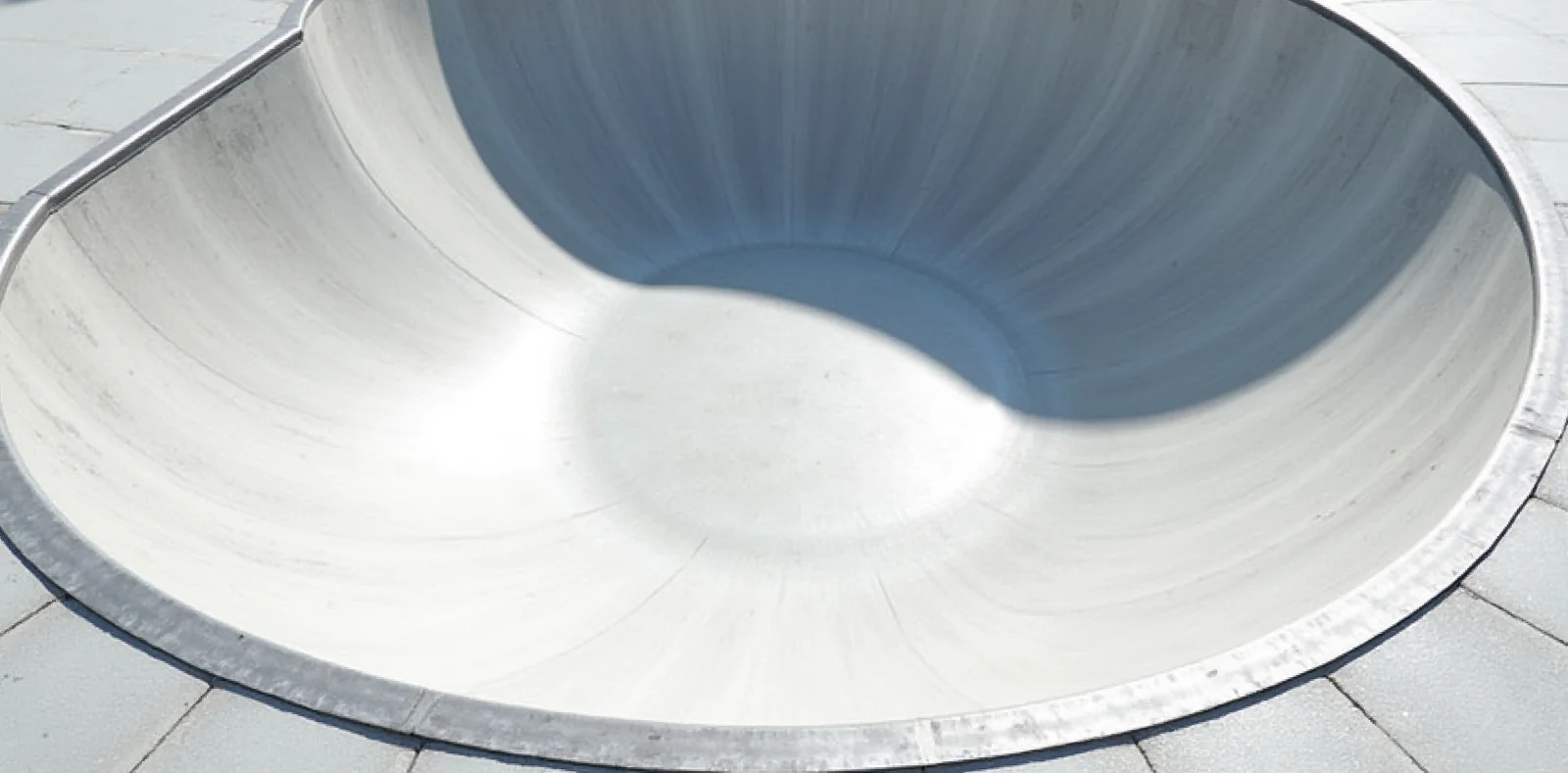
Transition parks are built around curved surfaces: bowls, half-pipes, and quarter pipes. The goal in a transition park is to learn how to ride from flat ground up a wall and back down without pumping. This skill, called a transition or a wall ride, is completely different from anything you learn on flat ground. Your body has to shift its weight forward and back in rhythm with the curve of the wall, and your board has to stay square to the surface the whole time. In my first year of coaching at a bowl park, I watched hundreds of beginners try to learn transition on the big bowl and quit because the walls were too tall. The correct approach is to start on a small quarter pipe or a low bowl (under 6 feet) and master the wall ride before you touch the deep bowl.
The bowl is not for beginners.
A full-depth bowl (the large pool-like feature most parks have) is an intermediate to advanced feature. The walls are often 10 to 15 feet tall, the coping is high, and the concrete is smooth. A beginner falling off the coping at the top of a bowl is a serious injury risk. If your park has a small bowl or a quarter pipe under 6 feet, start there. If your park only has a large bowl, learn your transition on a mini ramp or a street park first, then come back to the bowl once you can ride a wall smoothly on a smaller surface.
Bowl parks also teach pumping, which is the skill of generating speed by pushing your body and board in a rhythmic motion against the walls. Pumping is the foundation of all aerial tricks in the bowl. You cannot get air in a bowl without first being able to pump consistently. Most beginners underestimate how long pumping takes to learn. Plan on at least four to six weeks of focused pumping practice before you will feel consistent enough to try your first grab. The good news is that once pumping clicks, it is one of the most rewarding skills in skateboarding. The feeling of generating speed purely through body movement, without pushing with your feet, is something you will never get on flat ground.
Mini Ramps: The Best Aerial Introduction
Mini ramps are small half-pipes, usually 4 to 8 feet tall at the top, with a flat bottom. They are the single best feature for learning your first aerial tricks because the walls are low enough that a bad landing is a manageable fall, not a serious one. A 4-foot mini ramp is the ideal starting point for a beginner who has already learned to ollie and basic flip tricks on flat ground. You will practice your first ollie-to-flat (jumping up the wall and landing back on the flat bottom) on the mini ramp, then progress to your first grab, then to your first full air.
Vert Ramps: The Advanced Endgame
Vert ramps are large half-pipes or full pipes with walls that are at least 12 feet tall and go fully vertical at the coping. Vert skating is a discipline of its own within skateboarding, with its own competition format, its own trick vocabulary, and its own injury profile. Most skaters will never ride vert, and that is fine. If you are a beginner or intermediate skater, you should spend your time on street and transition features. Vert requires years of consistent practice, a strong landing base, and a high tolerance for the physical demands of landing big airs on flat ground.
Plaza and Flatground Parks: The Foundation Layer
Plaza parks are flat concrete surfaces with scattered small obstacles: a low box, a couple of ledges, maybe a small set of stairs. They are the best parks for absolute beginners because the flat ground is huge, which gives you room to practice without feeling cramped. If you are in your first month of skateboarding, a plaza park is the right environment. You will spend 80 percent of your time on the flat ground learning your ollie, your push, your turning, and your first flip tricks. The small obstacles give you something to work toward without being intimidating.
Which Park Type Should You Start With?
This is the question every beginner asks, and the answer depends on your current skill level. If you are in your very first month and still working on your ollie, go to a plaza or flatground park. The flat ground is your gym. If you can ollie consistently over small obstacles and land a basic kickflip, a street park is the next step. If you are comfortable on street features and want to add transition to your skill set, a park with a small bowl or a mini ramp is the right move. If you are an advanced skater already doing grinds and technical street tricks, a full transition park with a deep bowl is where you will make the biggest gains.
| Your Current Skill | Start Here | What to Focus On | Timeframe to Next Level |
|---|---|---|---|
| First month, working on ollie | Plaza / Flatground | Ollie, push, turning, basic kickflip | 4 to 8 weeks |
| Consistent ollie, first flip tricks | Street Park | Ollie to ledge, 50-50, boardslide | 2 to 4 months |
| Comfortable on street features | Mini Ramp or Small Bowl | Wall ride, pumping, first air | 1 to 2 months |
| Consistent transition, learning airs | Full Bowl / Transition Park | Advanced pumping, grabs, bigger airs | 3 to 6 months |
| Advanced street and transition | Vert Ramp (if available) | Vert ollie, landing style, big airs | 6+ months |
Source: Ska8 progression assessment based on coaching timelines, 2020 to 2026.
Safety in Different Park Types
Every park type has its own injury profile, and knowing what to protect against helps you choose the right gear for each session. On street parks, the main risks are falls on concrete (knees, elbows, wrists) and hits from the edge of ledges and stairs. Wrist guards and knee pads are the minimum. In the bowl, the main risks are hitting the coping at the top of the wall, getting hit by the board on a bad landing, and over-rotating on an air. A helmet is strongly recommended in the bowl at all times, not just for beginners. On vert, the injury profile shifts toward ankle and knee injuries from big landings, and the helmet is non-negotiable.
Helmet rule for the bowl.
If you are in the bowl and you are not a fully advanced skater, wear a helmet. This is not negotiable. The coping at the top of a bowl is a hard metal edge, and the speed you are generating with pumping means that a bad landing at the top can send you over the coping with enough force to cause a serious head injury. I have coached at bowl parks for a decade and the helmet saves you at least once per year. For street skating at a beginner to intermediate level, a helmet is strongly recommended but the wrist guards and knee pads are the priority. For vert, the helmet is always on. This is covered in more detail in our essential safety gear guide.
The other safety consideration that is unique to park skating is the difference between concrete and asphalt. Most parks are concrete, which is harder and less forgiving than the asphalt of a street. A fall on concrete that would be a minor scrape on asphalt can be a broken bone. This is another reason to wear wrist guards in the park even if you would not wear them on the street. Your wrists are the first point of contact when you fall forward, and on concrete they take the full impact.
Finding the Right Park Near You
Not every park is equally good for every skill level, and the quality of a park can change significantly depending on maintenance. A well-maintained street park with clean ledges and flat rails is worth ten times more for a beginner than a neglected park with chipped concrete and rusted rails. When you are evaluating a new park, look for three things: the condition of the concrete (cracked and chipped concrete is a safety hazard), the range of feature heights (a park with only high features is not beginner-friendly), and the overall size (a park that is too small will fill up quickly and you will be waiting for your turn on every feature). Most city and county parks departments publish park information online, and the Ska8 team is building a park directory to make it easier to find a good park in your area.
If you are in a city, start with your local parks and recreation department website. They will list every public skate park with a description of the features and sometimes a map. If the description is vague, search for the park name plus the word skate on YouTube. There is almost always a session video or a feature breakdown that will show you exactly what the park looks like and what the surfaces are like. If you are in a suburb or a smaller town, the options may be more limited, and you may need to travel to the nearest city for a good park. This is common and worth the drive if the park quality is good.
How Park Type Affects Your Progression Path
The most common progression mistake I see in coaching is a skater who is stuck on one park type for too long. A beginner who only goes to a bowl park will develop strong transition skills but weak street skills, which means they will struggle when they eventually want to learn grinds and technical footwork. A beginner who only goes to a street park will develop strong street skills but no transition foundation, which means they will have a hard time learning to ride a wall when they are ready. The ideal progression path moves between park types as your skill set demands it, not the other way around.
The balanced progression path.
A healthy progression path looks like this: months one through three are mostly flatground and plaza parks, building your ollie and basic flip tricks. Months three through six add street park time, focusing on ollie to ledge, 50-50, and boardslide. Months six through twelve add a small bowl or mini ramp, building your transition foundation and your first airs. Year two and beyond is where you specialize: either deep street, deep transition, or a balanced mix depending on what you enjoy most. There is no single correct path, but the balanced approach gives you the widest skill base and the most options for what you want to do next.
Frequently Asked Questions
What is the best type of skate park for a complete beginner?
A plaza or flatground park is the best starting point. The large flat area gives you room to practice your ollie, your push, and your first flip tricks without the pressure of obstacles. Once you can ollie consistently and land a basic kickflip, move to a street park to start working on ledges and small stair sets. Avoid the big bowl until you have at least six months of consistent skating behind you.
Can I learn transition tricks in a street park?
You can practice the body mechanics of transition in a street park by working on your ollie timing and your landing pattern, but you cannot practice the actual wall ride without a curved surface. The closest thing in a street park is a curved ramp or a quarter pipe, which some street parks include. If your street park has no curved surfaces at all, you will need to find a mini ramp or a small bowl park to build your transition skills.
What is the difference between a bowl and a half-pipe?
A bowl is a large, pool-shaped concrete feature with a flat bottom and curved walls on all sides. A half-pipe is a U-shaped ramp with two vertical walls (or one wall and one flat entry, in the case of a quarter pipe) and a flat bottom. Bowls are wider and more open, which makes them better for pumping and aerials. Half-pipes are narrower and more vertical, which makes them better for vert skating. Most parks have a bowl, some have a half-pipe, and a few have both.
Is it safe to skate a bowl without a helmet?
It is not recommended for any skater who is not fully advanced. The coping at the top of a bowl is a hard metal edge, and the speed you generate with pumping means that a bad landing at the top can result in a serious head injury. I recommend a helmet for all bowl skating until you are consistently landing airs without hesitation. For street skating at a beginner level, wrist guards and knee pads are the priority, but a helmet is still a good idea if you are working on new tricks.
How many different park types do I need to visit to be a well-rounded skater?
You do not need to visit every type, but you do need to spend meaningful time on at least two: a street park and a transition park. These two environments cover the full range of trick categories: street features teach you grinding, technical footwork, and ollie variations, while transition features teach you carving, pumping, and aerials. A skater who has spent at least six months on each type will have a much broader skill base than a skater who has spent two years on only one type.
See Also
- Essential Safety Gear for Skateboarding: What You Actually Need in 2026 — the complete gear breakdown for wrist guards, helmets, and pads by skill level.
- How to Choose Your First Skateboard: Complete Buyer’s Guide (2026) — deck size, wheel durometer, and truck setup for a board that matches your park.
- Best Skateboard Trucks in 2026: Complete Buyer Guide for Every Style — truck width, hanger length, and bushing setup for street vs. transition skating.
- Skate Parks: A Beginners Complete Guide (2026) — park culture, how to read a new park in five minutes, and the first-month park strategy.
Sources
- Wikipedia: Skate Park — overview of park types, construction, and history.
- Wikipedia: History of Skateboarding — the evolution of skateboarding from beach breakwater skating to purpose-built parks.
- Rider.com — manufacturer specifications for skateboarding protective gear, helmets, and wrist guards.
#Skateboarding #SkateParks #StreetSkating #TransitionSkating #BowlSkating #MiniRamp #VertSkating #SkateboardBeginner #SkateboardingTips #SkateParkGuide #Skateboarding2026 #LearnSkateboarding #SkateboardTricks #SkateSafety #Ska8
This guide is part of the ska8 daily series. Explore more below.