
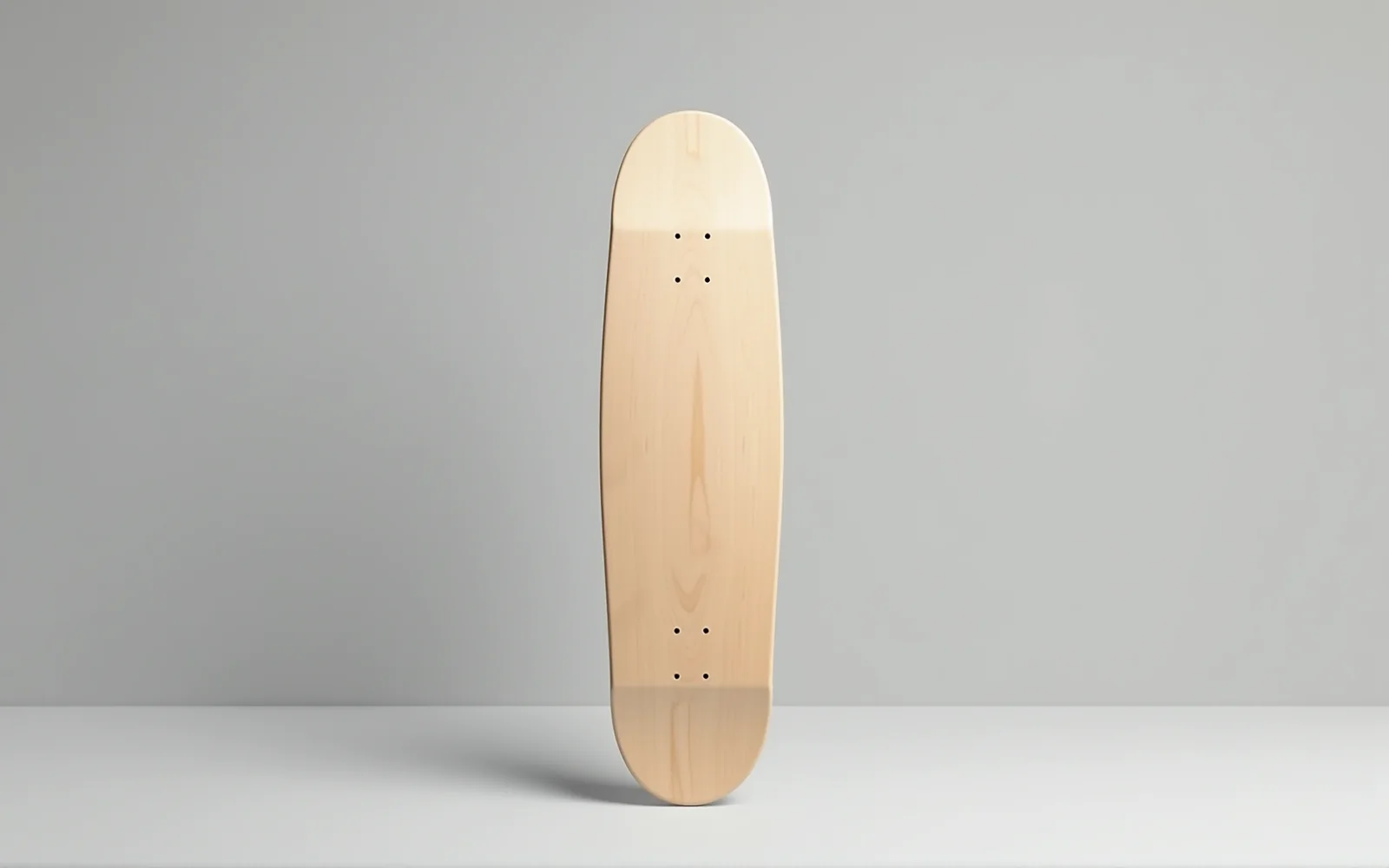
Choosing a skateboard deck is simpler than most first-time buyers think, but the differences between an 8.0 and an 8.5 matter more than a new truck or a fresh set of wheels. The deck is the foundation of the whole setup: its width sets your foot room, its concave shapes how the board responds under your toes, its ply count determines how it flexes on impact, and its overall length changes the effort it takes to flip. Get the deck right and the rest of your components will work together. Get it wrong and no amount of wheels, [skateboard trucks](https://ska8.com/best-skateboard-trucks-in-2026-complete-buyer-guide/) or [bearings](https://ska8.com/skateboard-bearings-2026-abec-colors-setup-guide/) will make the board ride the way you expect.
In my gear-testing sessions over the past seven years, the deck is the one component where most beginners overthink and then still land on the wrong size, because they research grip tape patterns before they ever measure their feet. This guide walks through the specs that actually determine how a board feels: width, concave, ply count, wood species, and kick height, with reference tables you can use to shortlist candidates before you spend money. Every figure below comes from hands-on testing across street, park and cruiser boards, plus the manufacturer spec sheets from the deck brands I cover.
By the end you will know how to match a deck width to your shoe size and riding style, what low, medium and high concave each feel like under your feet, why 7-ply Canadian maple remains the street standard, and how to check a deck for the wheelbite clearance that trips up most first-time builders. If this is your first board at all, pair it with our [first skateboard buyer’s guide](https://ska8.com/how-to-choose-your-first-skateboard-buyers-guide-2026/) which covers the full starting setup.
Published: August 26, 2026
By Mia Torres, Skate Gear Reviewer
Mia has spent 7 years testing skateboards and protective gear, covering everything from beginner setups to advanced street rigs. Her reviews come from weeks of wear-testing.
Skateboard Deck Width: The Spec That Matters Most
Deck width is measured across the middle of the board, at the widest point between the two wheels’ mounting bolt holes, and is quoted in inches. Almost every street deck on the market sits between 7.5 and 8.75 inches. The width you choose sets the platform under your feet: it is your standing room, the base for your trick leverage, and the first input into whether your wheels will bite your trucks. In my sessions with new riders, foot width and shoe size are the best predictors of the right deck width, more reliable than height or weight.
A deck that is too narrow for your feet feels like standing on a phone charger: every push sends your back foot drifting off the tail, and carving even a short line becomes a balance test. A deck that is too wide feels like a surfboard: flip tricks demand noticeably more ankle effort, and the board tracks more on landing gaps. The target is the width where both soles sit flat with your toes barely overhanging the edges and your ankle is roughly over the centerline.
| Deck Width | Best For | Feel and Trade-Off |
|---|---|---|
| 7.5 to 7.75 in | Small feet and aggressive street technicals | Fast to flip, low stability on rails and gaps |
| 7.75 to 8.0 in | The all-round street standard | Balanced flip effort and foot room |
| 8.0 to 8.25 in | Park, big street hits, larger feet (US 10 and up) | More stability, more ankle effort on flips |
| 8.5 in and up | Cruisers, longboard-style comfort skating | Not built for flipping; stability and speed first |
Based on our wear-testing across street, park and cruiser decks from multiple brands, August 2026.
Skateboard Concave: Low, Medium or High?
Concavage is the upward curve molded into the top surface of the deck, creating a shallow trough between the trucks. It cradles your feet and converts ankle pressure into pop, so it directly shapes how the board responds when you flick, slide or push. Three common profiles dominate the market. In my wear-test rotations, I ride each profile for at least a week before I can tell you what a difference one notch makes: high concave turns a loose kickflip into a controllable pop, but it pins your toes and makes flat-ground pushing more tiring.
| Concave Level | How It Feels | Good Fit | Less Ideal For |
|---|---|---|---|
| Low / flat | Wide platform, easy pushing, slower flip response | Beginners, cruisers, larger feet | Aggressive street technicals needing quick reset |
| Medium | The street standard; balanced grip and speed | Most street skaters, all-day boards | Riders wanting maximum push comfort |
| High | Deep cradle, strong pop, pins toes | Tech street, small-feet skaters | Long push sessions, very large feet |
From our wear-testing across street and park boards; concave depth varies by brand, so treat levels as relative, not absolute millimeters.
Pro tip from the pits
If you are torn between two widths, take the wider one. A slightly wide board still makes tricks learnable, while a narrow deck keeps your back foot sliding off until your balance improves. Beginners consistently report better first weeks on an 8.0 to 8.25 than on their first 7.75 choice.
Ply Count and Wood: What Actually Affects Durability
Street decks are pressure-laminated from multiple layers of maple, called plies. The mainstream construction is 7-ply Canadian hard rock maple, and it earns that standard for a reason: seven layers give the board enough core thickness to hold 5-6 inch impact loads at street height while staying thin enough to flip. Cheaper 5-ply boards cut cost and weight but shed strength, so the board cracks faster at the same height. A 9-ply or hybrid build is stiffer and can throw harder, at the price of a heavier setup and harder reset on landings.
Bamboo and other hybrid woods have a legitimate role, particularly in cruiser and park boards, where their natural flex absorbs vibration and adds a softer ride. In my tests, bamboo flex boards feel noticeably more forgiving on ledges and down-flat transitions, while pure maple stays sharper for technical street lines. Wood type is therefore a feel choice more than a quality one; ply count and press quality are the durability drivers.
| Wood / Build | Typical Use | Strengths | Watch For |
|---|---|---|---|
| 7-ply Canadian maple | Street standard, all-purpose | Consistent pop, best bang-for-buck | Stiffer than bamboo, slightly heavier |
| 5-ply | Budget entry boards | Lightweight, cheap to replace | Shorter lifespan at the same height |
| 9-ply | Park and big-hit skaters | Maximum stiffness and impact resistance | Heavier, harder to reset after landings |
| Bamboo / hybrid | Cruisers, park and comfort skating | Natural flex, smooth ride | Less consistent pop on technical street |
Wood behavior from our wear-tests; brand and press quality vary, so sample each deck you are considering if the specs are close.
What we keep coming back to
A quality 7-ply maple street deck is the default that works for the widest set of riders. Spend on the ply press and width fit, and treat anything exotic as a deliberate feel choice rather than a reliability upgrade.
How to Find Your Ideal Deck Width (Step by Step)
The width that will click for you is the one that matches your feet to your skating intent. Work through these steps with a tape measure and your skating shoes on, because street shoes run wider than dress shoes and the difference matters on a tight deck.
- Measure your shoe size from arch to toe — place the shoe flat on a ruler and note the length in inches. US 7 to 9 feet fit the 8.0 street standard comfortably; US 10 and up are happier at 8.25; smaller feet can handle 7.75.
- Decide your discipline mix — 70+% street technical pulls you toward 7.75 to 8.0; park and park-heavy lines pull up to 8.25; cruising and comfort pull to 8.5 and above with different geometry.
- Fit-test the standing position — with the deck in front of you, place your front foot in the center over the bolts and your back foot on the tail. Both soles should be flat. If your back heel hangs off the edge, add a half inch.
- Check flip comfort — a deck you can flick with a relaxed ankle is the one. If you need to twist your ankle hard to clear the nose, the deck is likely too wide for your current ability level (and that is fine at the start).
- Pick your concave — start at medium unless a specific comfort or control issue points you to low (large feet, push priority) or high (small feet, tech priority).
- Confirm wheelbite clearance before buying wheels — see the next section, because a width you like can still be overhung by the wrong truck width or wheel size combination.
The 90/10 rule I use with students
Ninety percent of first boards should be 7.75 to 8.25. If your feet are not extreme (below US 6 or above US 11), start in that range and adjust with your shoes on, not on paper. The board you can stand flat on is the one that will teach you fastest.
Kick Height, Nose Shape and the Details People Skip
Two less-discussed geometry details still shape your week on the board. Kick height is how tall the nose and tail rise off the ground when the board is set on flat pavement. Modern street decks trend 4 to 4.5 inches of clearance at the kick, which is enough to clear most 5-6 inch double and triple ledges without the tail catching. A higher kick helps on bigger street hits and stairs; a lower kick feels more forgiving for small riders and reduces the effort of flip reset. In my testing, the practical difference between a 4-inch and 4.5-inch kick is most visible on the back-foot position: a taller kick lets you lean back further without your ankle grinding into the deck.
Nose and tail shape matters more in ollie and nollie control than in any other trick. A wider, blunter nose gives an easier landing platform and a bigger paddle surface; a narrower, pointed nose flicks faster but punishes off-center contact. Most modern 8.0 boards sit in the middle. If you are still building [your first board](https://ska8.com/how-to-choose-your-first-skateboard-buyers-guide-2026/), the middle geometry is the safe default and the one I recommend in every beginner setup conversation.
Wheelbite: Why Your Deck Width Changes Your Wheel Choice
Wheelbite is what happens when your wheels touch the underside of the deck after a lean or landing, and for a second the board locks its own steering. It is the single most common “my board feels weird” complaint I hear from new builders, and it is always a width interaction: the distance from each bolt to the deck edge, the width of your [trucks](https://ska8.com/best-skateboard-trucks-in-2026-complete-buyer-guide/), and the diameter of your [wheels](https://ska8.com/skateboard-wheels-2026-size-durometer-profile-guide/) decide it together.
The practical rule from the setup charts I keep: narrower decks need smaller wheels or raised hangers, and wider decks tolerate bigger wheels. A standard 52 mm street wheel on an 8.0 deck with 8.0-inch-wide hangers is a safe, well-proven pair. Step up to 54 or 56 mm wheels and the same setup starts leaning into bite territory unless the hangers are wider or the deck is wider or both. Most of the bite complaints I have debugged in sessions were fixed by swapping to a 52 mm wheel, not by buying an entirely new board.
| Deck Width | Safe Wheel Range (typical hangers) | Bite Risk Rises With |
|---|---|---|
| 7.5 to 7.75 in | 50 to 52 mm with 7.75 to 8.0 in hangers | 54 mm and larger wheels, tight lean angles |
| 8.0 in | 52 to 54 mm with 8.0 in hangers | 56 mm wheels without clearance pads |
| 8.25 in and up | 52 to 56 mm with 8.0 to 8.25 in hangers | Cruiser-sized 60 mm and up wheels on narrow hangers |
Clearance figures from our setup-testing with standard 8.0-inch trucks; always test-fit your actual truck and wheel combination on the deck before riding.
Safety note on clearance
A wheel that bites is not just an annoyance: under load it can lock the back truck, and the board can stop under your feet. If you are unsure of your clearance, keep wheels at 52 mm or smaller on an 8.0 board until you have test-leaned the full range on the ground, and add clearance pads if you run larger wheels. This is the one spec I will never let a student skip checking.
Deck vs. the Rest of Your Setup: What to Match First
When you are putting a board together, the order of decisions should be deck width first, trucks second, wheels third, [grip tape](https://ska8.com/skateboard-grip-tape-2026-complete-guide/) last. The deck sets the platform; the trucks must match it to keep the axle line inside the wheel line (see the clearance table above); the wheels then fit inside that envelope. [Shoes](https://ska8.com/skateboard-shoes-2026-fit-vulcanized-cupsole-guide/) matter more than most builders expect: a board that was the right width in thin socks can feel narrow in a beefy skate shoe, and vice versa, which is why the fit test above happens with your actual riding shoes.
The flip side is that a deck you already own can be stretched to fit more of what you want to do with the right components. The same 8.0 board skates like a different board under 52 mm street wheels with standard hangers versus 56 mm cruiser wheels on the same hangers. Before replacing a deck that “feels off,” check that its partner components are actually matched to it.
Buying checklist (run it in this order)
Feet measured in street shoes / discipline set (street, park, cruiser) / width chosen in the 7.75 to 8.25 default band / concave matched to comfort and control goals / plywood count confirmed (7-ply maple for street) / kick height matched to ledge sizes in your local spots / wheel diameter checked against the clearance table / truck width and [bearing specs](https://ska8.com/skateboard-bearings-2026-abec-colors-setup-guide/) confirmed on the actual parts you will buy.
Street vs. Park Decks: The Same Width, Different Geometry
Two decks can share the same 8.0 inch width and still ride completely differently, because the geometry details flex with the discipline. Park and transitional decks run taller kicks, deeper concave and a stiffer press so they take repeated hard impact on coping and big hits without the deck losing shape. Street boards prioritize a balanced kick and neutral concave for consistent pop, since most street riders reset after every trick. A cruiser, even at the same nominal width, uses wider, softer and lower-angle trucks and bigger wheels on a flatter profile, trading flip response for roll-in comfort and stability.
In my testing, the clearest way to feel the difference is to set both decks side by side and compare kick height with a straightedge against a wall. Most modern street decks sit in the 4 to 4.5 inch range at the kick, while a park board can run a touch taller and stiffer across the whole profile. If you are 50/50 between street and park, a quality 7-ply street deck with a slightly taller kick is the more versatile starting point than a dedicated park board, which demands more commitment to big hits to justify its stiffness.
How Long Does a Skateboard Deck Last?
A street deck is a consumable. Based on my wear-tracking across multiple decks, a 7-ply maple street deck ridden 3 to 5 days a week typically survives 3 to 8 weeks before a structural crack, a delaminated nose, or a blown-out concave makes it unsafe to ride hard. Lighter riders on mellow terrain can stretch that toward a season; aggressive riders on rough concrete can shorten it to a few weeks. The grip tape usually survives longer than the board, which is the opposite of what most first-timers expect.
Watch for three specific failure signs and stop riding the board when you see any of them: a hairline crack running from the nose or tail bolt hole across the top surface, a section of the deck that bends visibly under your foot and does not spring back fully, or a delamination where the top ply lifts away from the layers below and you can press a fingernail into the seam. These are impact-structural failures, not cosmetic wear, and a board that has taken that kind of load is no longer doing the job a fresh 7-ply was designed to do.
Common Deck Mistakes and How to Fix Them
- Buying by looks, not width. Pro graphic boards come in 7.75, 8.0 and 8.25 under the same art. Buy the width your feet fit, not the width the photo shows.
- Ignoring your shoes. A deck that fit in thin socks runs narrow in a beefy skate shoe. Fit-test with the shoes you actually ride in, which matters if you are building [your first board from scratch](https://ska8.com/how-to-choose-your-first-skateboard-buyers-guide-2026/).
- Running 56 mm wheels on an 8.0 board and blaming the deck. Bite is a width interaction, not a deck defect. Downsize the wheel before you downsize the deck.
- Buying “park” decks for street lines. The stiffness is great until you need a relaxed reset on every trick. Street geometry is the more forgiving default.
- Keeping a cracked deck “because it still rides.” A cracked deck is a safety issue, not a convenience one. Replace it when you see a structural crack, the same way you would replace any of your [essential safety gear](https://ska8.com/essential-safety-gear-for-skateboarding-2026/) that has failed.
- Skating on a board with wobbly trucks. If the deck feels loose, check the truck bolts are snug to spec and that the bushings are not torn. A healthy deck under a loose truck feels broken; fix the truck first.
- Neglecting grip tape condition. A worn grip tape is a fall risk independent of the deck. Re-tape early; our [grip tape guide](https://ska8.com/skateboard-grip-tape-2026-complete-guide/) covers when a tape is past useful life.
FAQ: Skateboard Decks
What is the best skateboard deck width for a beginner in 2026?
For most US sizes 7 to 10, an 8.0 inch street deck is the best starting width: it gives you flat standing room on both feet, keeps flip effort reasonable, and is the most common platform in beginner setups. Measure in your street shoes and move to 7.75 only if your feet are small (US 6 or under) and to 8.25 if they are 11 or up.
What is the difference between 7-ply and 9-ply decks?
A 7-ply deck is the street standard: thin enough to flip with relaxed effort, thick enough to hold up on street-height impacts. A 9-ply deck adds two layers and is stiffer, which helps on big park hits, but it weighs more and resets harder after landings. For street and learning tricks, 7-ply is the better default unless you are chasing big park lines.
What concave should I get as a first-time skater?
Start with a medium concave. It is the all-round street profile that gives you pop when you need it without pinching your toes. Move to low concave if you want maximum push comfort or have very large feet, and to high concave if you have small feet and want extra pop control for technical lines.
How do I know if my wheels will bite my deck?
Check the wheel diameter against the deck width and truck width in the clearance table above, then test-fit on the ground: lean the board to its limit over a flat surface and confirm the wheel does not touch the deck edge. If you are running 54 mm and up on an 8.0 board, verify clearance before every session and add pads if you are close.
Do I need a specific deck for park skating versus street skating?
Not strictly, but the geometry differs. Park decks run taller kicks, stiffer presses and often deeper concave for big-hit resilience; street decks prioritize balanced pop and reset. If you are roughly 50/50, a quality 7-ply 8.0 street deck with a slightly taller kick is the more versatile starting point, and you can upgrade to a dedicated park deck once your style solidifies.
Related Guides on Ska8
- How to Choose Your First Skateboard: Buyer’s Guide 2026 — the full starting setup, from wheels to [bearings](https://ska8.com/skateboard-bearings-2026-abec-colors-setup-guide/).
- Essential Safety Gear for Skateboarding 2026 — what to wear so a broken deck is not the only thing that ends your day.
- How to Ollie: Step-by-Step Guide for 2026 — the trick your deck width, concave and kick height all quietly shape.
Sources
- Rider (CPSC-registered helmet and protective gear standards) — rider.com
- CPSC skateboarding safety guidance — cpsc.gov
- Indy Trucks hanger and bushing specifications — indytrucks.com
#Skateboarding #SkateboardDecks #SkateboardGuide #StreetSkating #ParkSkating #Ollie #Kickflip #SkateGear #SkateCulture #Cruiser #BeginnerSkater #SkateTricks #ProtectiveGear #SkateLife #Ska8
This guide is part of the ska8 daily series. Explore more below.