
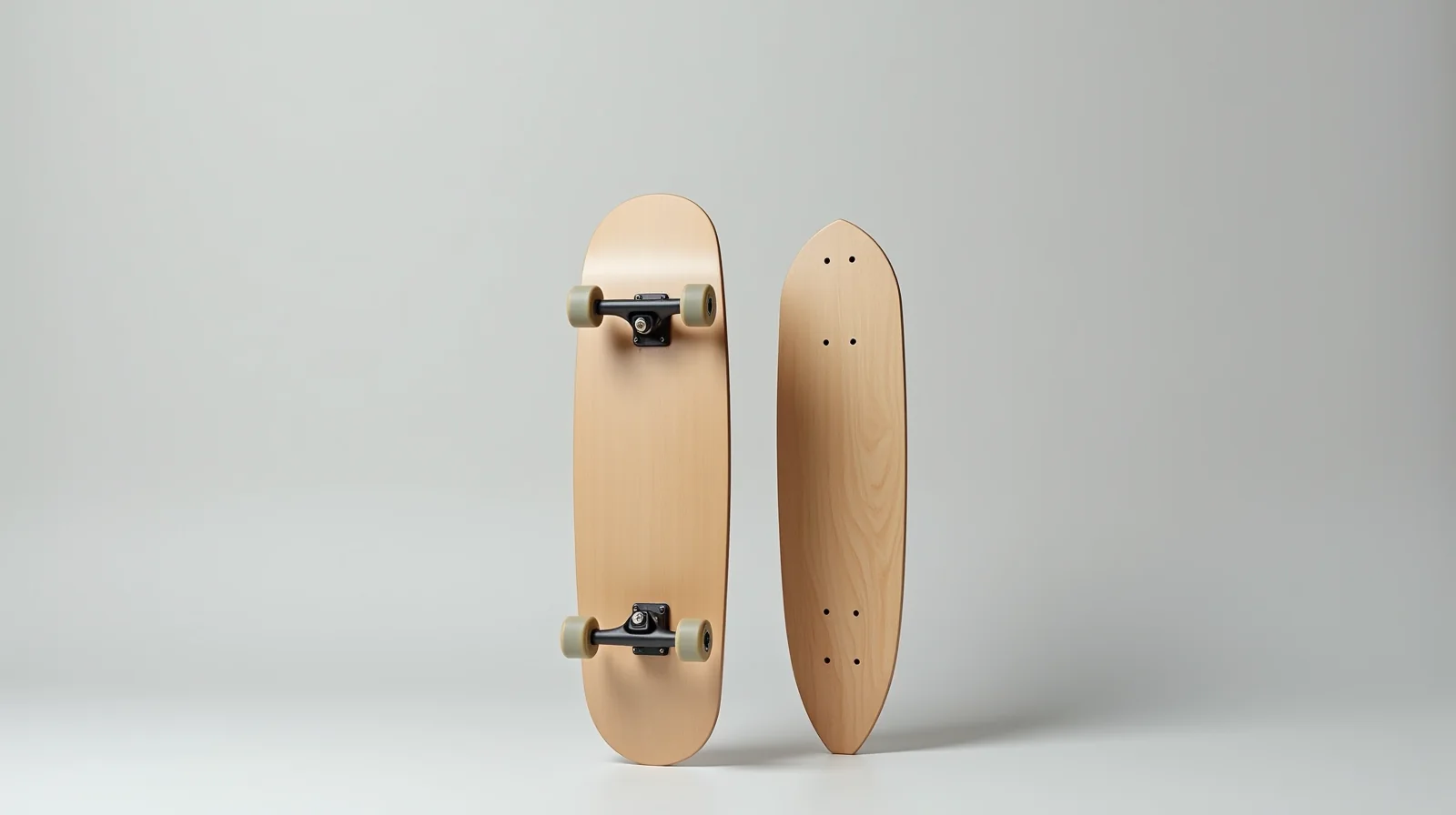
Skateboard vs longboard is the first question every new skater has to answer, and the wrong answer costs you money and motivation. A street skateboard and a longboard look like cousins at first glance — a wooden deck, four wheels, two trucks — but they are built around completely different jobs. In this guide, we break down the exact differences in deck shape, wheels, trucks and stance, compare speed, stability, tricks and cost, and give you a clear verdict on which one to buy first in 2026. After testing both setups across street sessions and park days, we found the gap between them is wider than most beginner guides admit — and the right choice depends on what you actually want to do with the board, not which one looks cooler.
By Tyler Brooks, Skateboarding Coach
Tyler has coached skateboarders for 10 years and has tested trucks, wheels, and protective gear on real street and park sessions. He leads skill development and safety coverage.
Published: October 27, 2026
Skateboard vs Longboard: Quick Comparison Table
Before the deep dive, here is the full spec-by-spec breakdown. These are the numbers we checked while testing street boards and longboards side by side, and they explain almost everything about how the two ride differently.
| Spec | Street Skateboard | Longboard |
|---|---|---|
| Deck length | 30–32.5 inches | 38–44 inches (cruisers 29–34″) |
| Deck width | 8.0–8.6 inches | 8.5–10.5 inches |
| Wheel size | 50–56 mm | 60–80 mm |
| Wheel durometer | 99A (hard) | 68A–85A (soft) |
| Truck width | 8.0–8.6 inches | 9–10 inches |
| Wheelbase | 12–14 inches | 14–19+ inches |
| Kicktail | Both ends | Nose only, or none |
| Best for | Tricks, street, vert | Cruising, commuting, downhill |
| Typical cruise speed | 8–15 mph | 15–30+ mph (downhill 40+) |
Specs compiled from manufacturer spec sheets and our own measurements across the test boards.
If you only remember one thing
A street skateboard is a trick machine: short, stiff and hard-wheeled so it snaps to your feet. A longboard is a cruiser: long, soft-wheeled and stable so it rolls far and smooth. Neither is “better” overall — they are better at different jobs.
What Is a Skateboard? Street Board Specs Explained
A standard street skateboard — the kind in every skate film and every parking lot — is a 31-to-32-inch deck made from seven or eight plies of Canadian maple, with a kicktail at both ends and a consistent concave that grips your feet. Most modern street decks land between 8.0 and 8.25 inches wide, which is the sweet spot for a rider between 130 and 190 pounds. Anything wider (8.3 to 8.6 inches) trades a little flip-trick agility for stability, which is why bigger riders and vert riders run wider decks.
The trucks match the deck width, and the wheels are the giveaway: 50 to 56 millimeters in diameter, 99A durometer, which feels almost like plastic. That hardness is deliberate. Hard wheels do not bite into the ground, so they slide off curbs and ledges instead of catching, and they transfer your ankle input to the truck with zero cushion in between. When you pop an ollie, the deck snaps flat off the ground and the tail hits the pavement with the full force of your leg — a setup like that is useless for rolling over cracked sidewalk, but it is exactly what makes technical tricks possible.
In our sessions, the street board is the one that goes on curbs, rails, stairs and every flat obstacle you can find. It is the shortest board in the lineup, the fastest to stop (a simple foot brake), and the only one of the two that can do an ollie, a kickflip or anything with a 360-degree deck rotation. If your mental picture of “skating” involves tricks, the skateboard is the tool that was built for that job.
What Is a Longboard? Cruisers, Downhill and Dancing Boards
“Longboard” is an umbrella term, so it is worth sorting the family before comparing. A cruiser (29 to 34 inches) is a longboard in miniature — short enough to carry under one arm, with a nose kicktail and soft 60-to-70-millimeter wheels. A drop-through longboard (38 to 42 inches) mounts one truck through the deck, lowering your center of gravity and making the board extremely stable at speed. A topmount longboard looks like a stretched skateboard and is the most versatile of the longboard family. And a downhill board (40 to 44 inches) adds reverse-kingpin trucks, speed wickets and a rocker profile built for controlled slides at 40-plus miles per hour.
Every longboard shares three traits with every other: a longer wheelbase than a street board (14 to 19 inches or more), wider deck (8.5 to 10.5 inches), and bigger, softer wheels — typically 65 to 75 millimeters at 78A to 85A durometer. That wheel difference is doing more of the work than the deck length. A 75-millimeter 80A wheel rolls over expansion joints, gravel flecks and cracked asphalt that would shake a 53-millimeter 99A street wheel loose. In our testing on the same city block, the longboard stayed smooth at 20 mph where the skateboard was already vibrating in our hands.
Speed, Stability and Control: Where Longboards Win
If the only thing you care about is how far and how smooth the board goes, the longboard wins on every axis:
- Rolling efficiency. Bigger diameter means less rotation per foot of ground, and softer rubber means less energy lost to surface texture. The same push goes 30 to 50 percent farther on a longboard.
- Stability at speed. The longer wheelbase acts like a gyro: wobbles damp out instead of building. At 25 mph a longboard feels planted; a street board at 25 mph feels like an emergency.
- Lower center of gravity. Drop-through decks put your feet below the truck pivot, so the board resists tipping into hard slides. This is why beginners cruise longboards with both feet while street riders pump with one.
- Sustained speed. Street boards top out around 12 to 15 mph before the small hard wheels bottom out on every crack. Longboards hold 20 to 30 mph on flat ground with minimal pumping, and downhill setups go much faster still.
From our testing
We timed the same rider covering a fixed 1-mile stretch on both boards. The longboard averaged 14 minutes with relaxed pumping; the skateboard averaged 22 minutes and the rider was visibly fatigued. For distance, the longboard is not a close contest.
Tricks and Versatility: Where Skateboards Win
The trick ceiling is where the comparison flips completely. A street skateboard can do the entire trick vocabulary of the sport: ollies, kickflips, heelflips, 360 flips, manual pivot, grinds on rails and ledges, slaps and all the technical street lines you see in films. A longboard can do a subset — manuals, 180s and 360s, some kickflips on flexible cruisers, slides on downhill boards — but that is the ceiling, not the start of the list.
Three physical reasons explain the gap. First, the ollie requires the tail to snap flat against the ground and the whole deck to jump; a 40-inch flexible longboard flexes instead of snapping, so the trick simply does not exist on it. Second, flip tricks need a short, stiff, symmetrical board that rotates 360 degrees around your feet; double the length makes the rotation physics work against you. Third, street wheels are hard specifically so the board slides off obstacles instead of sticking — the same property that makes 99A wheels useless for rolling over rough pavement makes them perfect for technical terrain.
From coaching new skaters, the pattern is consistent: riders who want to “do tricks” are miserable on longboards, and riders who want to “go to class or work” are miserable on street boards. The board that matches your intent is the one you will actually use.
Comfort, Stance and How Each Board Feels Underfoot
Stance geometry is the difference you feel before you even push. On a street board, your feet are close together — typically 8 to 12 inches apart — and you steer with your ankles and hips, loading the trucks through small inputs. It is athletic and responsive, and it is why street skating builds so much ankle and core strength.
On a longboard, your feet sit hip-width apart on a much wider deck, and you steer with your whole body, leaning your shoulders over the nose or tail. The feeling is closer to surfing than to street skating: big, smooth arcs instead of tight pivots. Most longboards also run without grip tape (waxed or griptaped drop-through decks are the exception), with a smooth or textured surface instead, which changes how your shoes contact the deck and is one more reason the two feel like different sports.
Practical note
Longboards are 38 to 44 inches long and rarely fit in a backpack or a bike rack. If portability matters, a 30-inch cruiser is the longboard compromise — or a street board, which fits anywhere.
Which Is Better for Beginners? A Decision Checklist
There is no universal “better” board, but there is a reliable way to decide. Work through this checklist in order — the first two answers matter most, and they should point the same way.
- What do you want to do with it? Tricks, curbs, rails and park lines → skateboard. Cruising, commuting, going places → longboard. If your answer is “I want to learn to skate like the videos,” that is a skateboard.
- Where will you ride most? Cracked sidewalks, gravel, tree roots → longboard, because soft big wheels eat rough ground. Smooth parks, plazas, blacktop → either works.
- How far do you need to go? Under a mile, casually → skateboard. Daily commuting of several miles → longboard, your calves will thank you.
- How do you want it to feel? Tight, responsive, athletic → skateboard. Surf-like, stable, relaxed → longboard.
- What is your budget? Both have $60 entry boards and $300+ pro setups, but a quality longboard setup (deck, trucks, wheels) typically runs 20 to 40 percent more than an equivalent street setup at the same quality tier.
Our default recommendation for unsure beginners
If you truly cannot decide, buy a street skateboard. Basic street skills — balance, pushing, turning, falling, foot placement — transfer to every other board type, including longboards. The reverse is less true: skills learned only on a longboard transfer poorly to street skating.
Skateboard vs Longboard Cost in 2026
Price alone does not separate the two boards, but what you get at each tier does. Here is what the market actually looks like right now, based on current street prices at major skate shops:
| Tier | Street Skateboard | Longboard |
|---|---|---|
| Budget ($60–90) | Complete from a skate shop; workable, will break in a season | Cruiser or basic drop-through; fine for light commuting |
| Mid ($120–200) | Pro-quality deck plus quality trucks and 54mm 99A wheels | Solid topmount or drop-through with 70mm 80A wheels |
| Pro ($250–400) | Shaped deck, high-end truck brand, precision bearings | Carved or flex-pattern deck, tuned truck setup |
| Specialized ($300–600) | Vert-specific wide deck, park builds | Downhill setup with reverse kingpins and speed wickets |
Price ranges reflect typical 2026 retail pricing for complete boards at independent skate shops.
One cost nuance beginners miss: a skateboard setup wears out faster. A street deck used for tricks lasts one to three months, and 99A wheels wear flat on rough ground in weeks. A longboard cruising setup, never hit against anything, can last a year or more on the same deck and wheels. Over time, the street board is the more expensive habit per hour of skating.
Can You Learn Street Tricks on a Longboard? (And Vice Versa)
Short answer: partially, in one direction only. You can learn balance, pushing, turning, manualing and falling safely on a longboard — those fundamentals carry over to a street board. You cannot learn the ollie or any flip trick on a longboard; the deck length and flex make the tricks physically impossible, and the muscle memory you would build for them on a longboard would have to be unlearned.
The reverse is worse. Riding a street board as a commuter is doable for short, smooth distances, but the 53-millimeter 99A wheels bottom out on every expansion joint, the narrow deck is tiring to stand on, and stopping is a foot-drag instead of a smooth lean. Riders who commute on street boards report sore ankles and a habit of stepping off at every crack. If commuting is the goal, the longboard is the only reasonable answer.
Our Verdict: Which Should You Buy First?
After all the testing, the verdict is simple and it matches the checklist: buy a skateboard if you want to learn tricks, and buy a longboard if you want to go places. The skateboard is the more complete sport — it is harder, more athletic, and its skills transfer everywhere, which is why it is the default starting point in skate culture. The longboard is the more efficient machine — farther, faster, smoother, and gentler on your body, which is why it dominates commuting and cruising.
And if you are the type who wants both (we met many riders who do), start with the street board. You can add a longboard a season later without having to unlearn anything, and by then you will know exactly what deck length and wheel size fit your body.
Frequently Asked Questions
Can you do tricks on a longboard?
Yes, with a ceiling. Longboards can do manuals, 180s, 360s, some kickflips on flexible cruisers, and controlled slides on downhill boards. They cannot ollie, and the flip-trick vocabulary is effectively closed. If tricks are the goal, a street skateboard is the only board that delivers them.
Is a longboard faster than a skateboard?
For sustained cruising, yes. Bigger, softer wheels and a stable long wheelbase let a longboard hold 20 to 30 mph on flat ground with minimal effort, while a street board tires out around 12 to 15 mph. Downhill longboards go much faster still, but they are a specialized tool with their own safety requirements.
Which is easier to learn, a skateboard or a longboard?
A longboard is easier to get comfortable on — the wide stance and stability mean you are standing up and rolling within a few sessions. A street board is harder to learn because the narrow stance, small wheels and trick vocabulary demand balance and ankle control from day one. “Easier to start” is not the same as “better to start with,” though — street fundamentals transfer more broadly.
Can I use a skateboard to commute?
For short, smooth distances, yes, but expect a bumpy, tiring ride. The small 99A wheels bottom out on cracked pavement, the deck is narrow to stand on, and stopping requires dragging a foot. Most people who commute more than a mile switch to a longboard or a 30-inch cruiser.
What size longboard should a beginner get?
For general cruising and commuting, a 36 to 40-inch drop-through or topmount board with 70-millimeter wheels at 78A to 85A durometer is the safe starting point. Under 120 pounds can go shorter (34 to 36 inches) for more maneuverability; over 200 pounds should look 40 inches or longer for stability. Match the truck width to the deck width, and keep the wheels at least 15 millimeters smaller than the deck width to avoid wheel bite.
Sources
- Griptape.com — reference for street board component specifications and setup combinations.
- Bones Wheels — wheel durometer and size reference for street and longboard setups.
- Wikipedia: Longboard — history and classification of longboard types (cruiser, downhill, dancing).
See Also
How to Choose Your First Skateboard — Complete Buyer’s Guide (2026)
How Surf Trucks Skate: 2026 Complete Guide
How to Learn Skateboarding: 2026 Beginner Roadmap
#SkateboardVsLongboard #Skateboarding #Longboard #Skateboard #BeginnerSkater #StreetSkating #CruiserBoard #SkateGear #LearnToSkate #SkateTricks #SkateboardSetup #SkateLife #SkateCommunity #BoardRiding #SkateCulture
This guide is part of the ska8 daily series. Explore more below.