
Published: September 16, 2026 • Updated: October 11, 2026
By Mia Torres, Skate Gear Reviewer
Mia has spent 7 years testing skateboards and protective gear, covering everything from beginner setups to advanced street rigs.
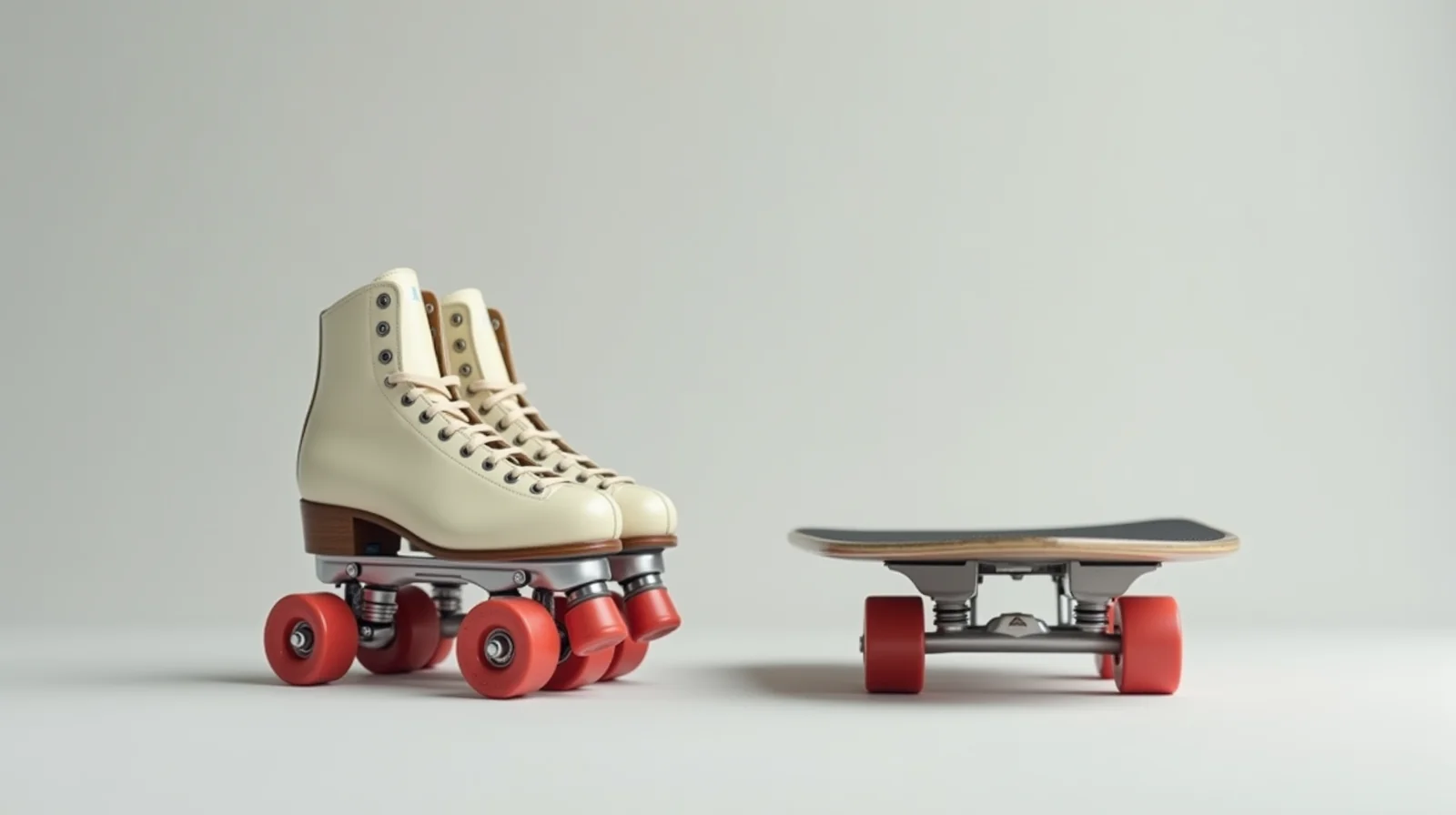
Every few weeks I get the same message, usually in some form of the phrase “roller skates board” — which one should a beginner actually start on, quad roller skates or a flat skateboard? People want to roll, but they are not sure whether the answer is a pair of quad roller skates or a standard skateboard. I have spent the past seven years testing both on real pavement, at rinks, and in parks, and the honest answer is not “skateboard, obviously.” The two platforms train different muscles, cost different amounts, and carry different risks. The right choice depends on what you want out of the ride more than on which one looks cooler.
In this guide I will compare roller skates and skateboards across the things that actually matter to a beginner: how hard they are to balance on, how fast they go, how they stop, what they cost, what gear you need, and how the injuries break down. I will also answer the questions that show up most in my inbox, and I will give you a short checklist at the end so you can pick the right one for your situation in about a minute.
One note before we start: when people say “roller skates” they usually mean quad skates — the four-wheeled skates with a boot on top. “Rollerblades” or inlines are a different animal (wheels in a single line), and I cover those in a separate piece. This article is specifically about quad roller skates versus a skateboard, which is the comparison that comes up most often.
Roller Skates Board: What the Term Actually Means
If you landed on this page searching for a “roller skates board,” you are not alone. That phrase comes up a lot, and it usually means one of two things. Most often it is a casual way of asking the roller skates versus skateboard question, which is exactly what this guide answers. Sometimes it points to a hybrid board with long, surfer-style trucks that carve like a quad skate, and a few brands market those boards with “roller board” style names. This is a beginner-focused site, so I will keep the focus where the question comes from: quad roller skates versus a standard skateboard.
To keep everything clear, here is how I use the terms in this article. “Quad roller skates” are the four-wheeled skates with a boot, a plate, and a toe stop. “Inlines” or “rollerblades” are the wheels-in-a-row skates, which get their own separate guide. And a “skateboard” is the flat, gripped, four-small-wheels board that most people picture when they hear the word. Once those three are separated, the comparison below gets a lot simpler.
The Short Answer: Which Is Easier to Learn?
If your only question is balance on day one, quad roller skates are easier to stand up on. The four wheels are set in a wide rectangle under each foot, which gives you a genuinely stable base — closer to standing on two small platforms than to standing on a single line. Many people can shuffle around in roller skates within ten to fifteen minutes of lacing up.
A skateboard is harder to stand up on, and the learning curve is steeper in the first session. You are balancing on a single, narrow, free-rolling plank, and the front and back wheels are not fixed to a frame. But once you pass that first wall, a skateboard is cheaper, more portable, and far more versatile than a pair of roller skates. The “easier” answer flips depending on which wall you find more comfortable clearing.
In One Line
Roller skates are easier to stand on and stop; a skateboard is cheaper, lighter, and more fun once you can balance. Pick roller skates if you want stability on day one, pick a skateboard if you want the best value and the most things to do.
Balance and Stability: The Wide Base vs. the Narrow Plank
The single biggest difference between the two platforms is the base of support. A pair of quad skates puts roughly a 4-inch-by-6-inch footprint under each foot, and the two feet are shoulder-width apart. That gives you a wide, forgiving platform. When your balance drifts left or right, you have a fair bit of room to correct before you tip.
A skateboard gives you about 8.5 inches of length by 8 to 8.25 inches of width, and you stand with your feet about 12 to 18 inches apart along that narrow plank. The board itself is stable — it does not wobble on its own — but there is very little margin in the sideways direction. Lean past the edge of the trucks and you are on the ground. That is why the first skateboard session is almost always a session of falling off the side of the board while trying to stand still.
There is a counterintuitive detail here that trips people up. A skateboard actually feels more stable when you are moving than when you are standing still. The rolling motion helps your balance find its center, the same way it is easier to ride a bicycle than to stand on it. Roller skates are the opposite: they feel stable while you are planted, and the balance work shows up when you start turning and carving. So neither platform is uniformly “easier to balance” — it depends on whether you are moving or stopped.
What I Noticed in Sessions
When I put absolute beginners on quad skates, most of them are rolling within the first ten minutes and their first falls are usually from trying to stop too hard. When I put the same people on a skateboard, the first falls are from leaning off the edge while standing still. The skateboard has a higher fall rate in hour one, but it levels off faster.
Speed: How Fast Does Each One Go?
Roller skates are the faster platform in most real conditions, and the reason is wheel size and wheel count. A typical beginner quad skate has four 4.5-to-5.5-inch wheels, and those larger wheels roll over cracks and seams in pavement that would stop a skateboard dead. A skateboard has four small wheels — usually 52 to 56 millimeters in diameter, or about 2 to 2.25 inches — set low on the trucks.
On a smooth, flat surface the two platforms can feel about the same at a casual pace. But on anything with texture, or when you are going downhill, the roller skates pull ahead because the bigger wheels keep momentum. A skateboard on a rough sidewalk or a cracked driveway will shake, slow, and eventually stop; the same surface is often fine for roller skates. If you want to cruise a neighborhood at a relaxed pace and you do not care about doing tricks, roller skates will feel quicker and smoother.
Stopping: The Toe Stop vs. the Foot Drag
This is the area where roller skates are clearly the more beginner-friendly platform. A quad skate has a toe stop — a block of rubber on the front of each boot. You lift your front foot and press the toe stop into the ground to brake. It is a real, dedicated braking system, and once you learn it you can stop on demand, even at speed.
A skateboard has no brake. You stop by dragging your back foot on the ground (a foot brake or “stopping slide”), and that works fine at low speed on smooth pavement. But it wears out your shoes, it is not reliable at higher speed, and it does nothing useful on a steep hill. Skaters who go fast or ride hills add a slippery backside or learn to push out of turns, but none of that is a beginner stop. If stopping safely is a priority for you or for a child, the toe stop on roller skates is a genuine advantage.
Cost: What You Will Actually Spend
Here is where the skateboard pulls ahead hard. A complete, rideable skateboard in 2026 runs roughly $60 to $120 for a solid beginner setup — deck, trucks, bearings, wheels, and grip all included. You can find a decent complete at a local skate shop or a major retailer for less than a hundred dollars, and it will hold up to years of casual use.
A pair of quad roller skates is a different story. Because each skate is essentially a boot plus a plate plus four wheels plus a toe stop, you pay for more material and more assembly. A decent beginner quad skate costs about $80 to $150 per pair, and good mid-range skates for derby or rink skating run $150 to $300. Budget “roller skates” under $50 do exist, but they are usually flimsy plastic-plate models that break or wobble within a season. So for roughly the same money as a skateboard, you might be looking at the very bottom of the roller skate range.
Value Note
Per dollar, the skateboard is the better buy. One complete costs about the same as a single pair of entry-level quad skates, and a skateboard lasts for years with almost no maintenance. If budget is your main constraint, the skateboard wins on cost per hour of riding.
Portability and Storage: A Plank vs. Two Boots
A skateboard wins here by a wide margin. The whole thing is one flat object that weighs about 7 to 8 pounds. You can carry it under one arm, strap it to a backpack, throw it in the back of a car, or ride it and then walk it a block to the spot you want to hit. That portability is a big part of why skateboarding became a culture: the entire sport travels with you.
Roller skates are two separate boots that you have to walk in. You cannot carry them without putting them on, and once you are wearing them you are committed to skating wherever you are. A pair of quad skates weighs roughly the same as a skateboard in total, but split across two feet, so you cannot easily pick them up and go. You also need a flat, smooth surface to skate them, which limits where you can use them. For anyone who lives in an apartment, uses public transit, or wants to carry their gear between spots, the skateboard is the practical choice.
Versatility: What Can You Actually Do With Each One?
This is the section that matters most, because “which should I buy” is really “what do I want to do.” A skateboard is a platform for tricks and terrain. You can push off curbs, ollie onto ledges, grind rails, ride in a skatepark, cruise the streets, and do a huge range of technical and aerial tricks. The entire modern skateboarding world — street, park, vert, bowl — is built around the skateboard. If you want to do tricks, the answer is already decided.
Roller skates are a platform for sport and social skating. The main things people do on quad skates are roller derby, rink skating, social or “flat” skating at a rink or on a smooth plaza, and a lot of just-cruising-for-fun. The wide base and toe stops make quads well suited to the fast, body-close contact of derby and to the sustained carving of rink skating. If your goal is roller derby, roller disco, or just cruising a smooth plaza with friends, the skateboard is the wrong tool and the roller skates are exactly right.
The clean way to think about it: skateboards are for terrain and tricks, roller skates are for speed, derby, and social skating on flat ground. If your vision of a fun ride includes rails, ramps, and curbs, get the skateboard. If your vision includes a rink, a derby league, or just smooth cruising, get the roller skates.
Roller Skates vs Skateboard: Side-by-Side Comparison
| Factor | Quad Roller Skates | Skateboard |
|---|---|---|
| Balance (day one) | Easier — wide 4-wheel base, stable while planted | Harder — narrow plank, falls off the side |
| Top speed | Faster — larger wheels keep momentum | Slower — small 52-56mm wheels |
| Stopping | Toe stop, reliable at speed | Foot drag only, low-speed only |
| Cost | $80-150 beginner, $150-300 mid | $60-120 complete |
| Portability | Wear them, cannot carry | Carry under one arm, 7-8 lb |
| Best for | Derby, rink, cruising, social skating | Tricks, street, park, terrain |
| Learning curve | Gentle start, steeper once turning | Steeper start, smoother once rolling |
| Surface tolerance | Rolls over cracks and seams | Needs smooth, flat ground |
Prices are 2026 retail ranges for entry-level gear in the US; local skate shops and major online retailers typically match these.
Injuries and Safety: How the Falls Break Down
The two platforms produce different injuries, and knowing the difference helps you buy the right protective gear. On a skateboard you fall sideways or backward off the board, usually onto your tailbone, hip, or hand. The most common skateboarding injuries are wrist fractures and sprains (from putting a hand down), plus scrapes and bruises to the elbows and knees. Because you are often moving faster and hitting harder ground, head injuries are a real risk, which is why a properly fitted helmet is non-negotiable for anyone new to the sport.
On roller skates the falls tend to be more forward and more sudden, because the wide base makes you feel confident and then a turn or a toe-stop slip sends you forward onto your hands. In roller derby the most common injuries are ankle sprains, shoulder injuries from hard falls, and concussions from collisions between skaters. The ankle is the weak point on quads — balancing on a single line of four wheels under a boot puts real stress on the ankle joint, especially during fast carving and derby checks.
Safety Bottom Line
Both platforms need the same core protection: a helmet, wrist guards, and knee pads. Skateboarders should prioritize a helmet and wrist guards (falling backward onto hands). Roller skaters should add ankle support, especially if they plan to do derby or a lot of fast carving. Whatever you ride, the first session should be on a smooth, empty surface in full pads — not a busy street or a full rink.
Where Each One Works Best (and Where It Fails)
A skateboard thrives on flat, smooth, urban terrain: smooth concrete, plazas, skateparks, and any surface with features to ride. It fails on rough, cracked, or bumpy ground, on long grass, and on anything steep without a lot of practice. It is also the wrong tool for sustained high-speed cruising on uneven pavement.
Roller skates thrive on smooth, flat, open surfaces: rinks, plazas, and long smooth stretches where you can build and hold speed. They fail on stairs, curbs, and rough pavement — the four smallish wheels under a boot cannot absorb what a skateboard deck and small wheels can, and you cannot ride a quad skate up a curb the way you can pop a skateboard over one. They are also less practical in wet weather, because the wide base and toe stops are not designed for water.
In short: if your neighborhood is full of smooth plazas and a local rink, roller skates are a great fit. If your world is streets, curbs, and a nearby skatepark, the skateboard fits your life far better.
Your First Session: A Step-by-Step Plan
Whichever platform you pick, the first session should be low-pressure and on a smooth, empty surface — a closed parking lot, a smooth plaza, or a quiet stretch of pavement. Here is the order I would follow if I were starting from zero on either one.
- Pull on your pads first. Helmet, wrist guards, and knee pads on before you even put on the gear. This is the one step that changes your whole session, because you are less afraid to fall.
- On roller skates: practice the toe-stop while standing still, then walk on the skates a few steps before you try to roll. On a skateboard: start on one foot on the tail with the other on the ground, and practice standing still until it stops feeling wobbly.
- Move slowly and keep your knees bent. Bending your knees lowers your center of gravity and gives you room to correct your balance. This is the single most important body position on both platforms.
- Practice stopping before you practice going fast. You should be able to stop on command before you ever push hard. On skates that means the toe stop, on a board it means the foot drag.
- Add turns and carving. On skates, lean and carve in wide S-shapes. On a board, lean into turns with your shoulders, not your arms.
- End with a session that ends on your own terms. Stop while you are still in control, not when you are exhausted. A short, controlled session is worth more than a long, chaotic one.
What Gear You Actually Need
Both platforms share a core safety kit, but the rest is where they diverge. Here is the list.
- Helmet (both, non-negotiable). A skate-specific or multi-sport helmet that fits snug and level. See our skateboard helmet fit guide for how to size it correctly.
- Wrist guards (both, but more important for skaters). Skateboarders put a hand down constantly, so good wrist guards are a must. Roller skaters need them too, especially for derby.
- Knee and elbow pads (both). The basic protection for any fall. Cheap pads are fine to start; upgrade as you get serious.
- Ankle support (roller skates, especially for derby). A supportive boot or a wrap helps with the ankle stress of balancing on a single line of wheels.
- Skate shoes (skateboard). Flat, grippy vulcanized shoes protect your feet and give you board feel. See our skateboard shoes guide for vulcanized vs cupsole.
- Skateboard (obviously). A 8.0- to 8.25-inch wide complete is the right size for most beginners; see our first skateboard buyer’s guide for the full breakdown.
Frequently Asked Questions
Are roller skates easier to learn than a skateboard?
For balance on day one, yes — the wide four-wheel base makes roller skates easier to stand up on. But a skateboard becomes easier faster once you are moving, and it is cheaper and more versatile. Neither is “easier” overall; they are easier in different ways.
Which one is cheaper to start with?
The skateboard. A complete board runs about $60-120, while a pair of decent quad roller skates runs $80-150 at the entry level and more for mid-range. Per dollar of riding time, the skateboard is the better value.
Can I use a skateboard for roller derby?
No. Roller derby is a quad-skate sport. You need roller skates (specifically derby- or rink-rated quads), not a skateboard. The wide base and toe stops are what make the fast, close-contact skating possible.
Do roller skates or skateboards cause more injuries?
Both, but different ones. Skateboarders most often injure their wrists, hands, and tailbone from falling off the board. Roller skaters, especially in derby, most often injure ankles, shoulders, and heads from forward falls and collisions. Wearing a helmet and pads on either platform cuts the serious injuries sharply.
What if I just want to cruise and have fun?
If “cruise” means a smooth plaza or rink with friends, roller skates are a lot of fun and go faster. If it means rolling through your neighborhood, over small curbs, and to a park, the skateboard is more practical. Pick based on the surface you actually have.
What exactly is a roller skates board?
There is no single piece of gear called a “roller skates board.” The phrase is usually a loose way of asking about quad roller skates versus a skateboard, or it points to a carving surfskate or cruiser with long trucks. If you want the stable, toe-stop, rink-and-derby ride, you want quad roller skates. If you want the cheap, portable, tricks-and-terrain platform, you want a skateboard. This guide compares both so you can choose based on what you actually want to ride.
Does a roller skates board cost more than a skateboard to start?
For most people, yes. A quad roller skates board setup starts higher because you are buying two sized boots plus wheels and bearings, not a single pre-assembled plank. A skateboard is usually the cheaper first purchase and cheaper to keep rolling, since wheels and bearings are cheap refills. The table below puts the 2026 numbers side by side.
| Item | Quad roller skates | Skateboard |
|---|---|---|
| Entry set | $150-$300 | $80-$200 |
| Gear included | Skates only, boots sized to you | Deck, trucks, wheels, grip, bearings |
| Refills (wheels / bearings) | $40-$90 every 2-3 years | $20-$60 every few months |
| Storage footprint | Two boots, needs a rack | One plank, fits under a desk |
Typical 2026 retail ranges from manufacturer spec pages and national skate shop pricing.
Which is better for a beginner, a skateboard or a roller skates board?
For most beginners, a skateboard. It is stable on two wide wheels, it is cheaper to fall off of, and the learning curve is forgiving. A roller skates board setup rewards balance and a flat, smooth surface, which makes it great for rinks and plazas but harder to practice on rough neighborhood streets. Start with the surface you will actually have: smooth indoor or plaza surfaces favor roller skates, mixed outdoor terrain favors the skateboard.
See Also
- How to Choose Your First Skateboard — Buyer’s Guide — deck width, setup, and what to buy if you go the skateboard route.
- Inline Skating for Beginners 2026 — the inline-skate (rollerblade) side of the “which wheels” question, for month one.
- Essential Safety Gear for Skateboarding — helmets, wrist guards, and pads that apply to either platform.
Sources
- Rider.com — skateboarding equipment and setup reference
- Indy Trucks — truck geometry and setup guides
- Roller skating — history, quad vs inline, and derby overview
#RollerSkatesVsSkateboard #Skateboarding #RollerSkates #QuadSkates #BeginnerSkater #SkateboardGuide #WhichIsEasier #Skateboard2026 #SkateboardingTips #LearnToSkate #InlineSkating #SkateGear #SkateboardComparison #SkateLife #SkateSafety
This guide is part of the ska8 daily series. Explore more below.