
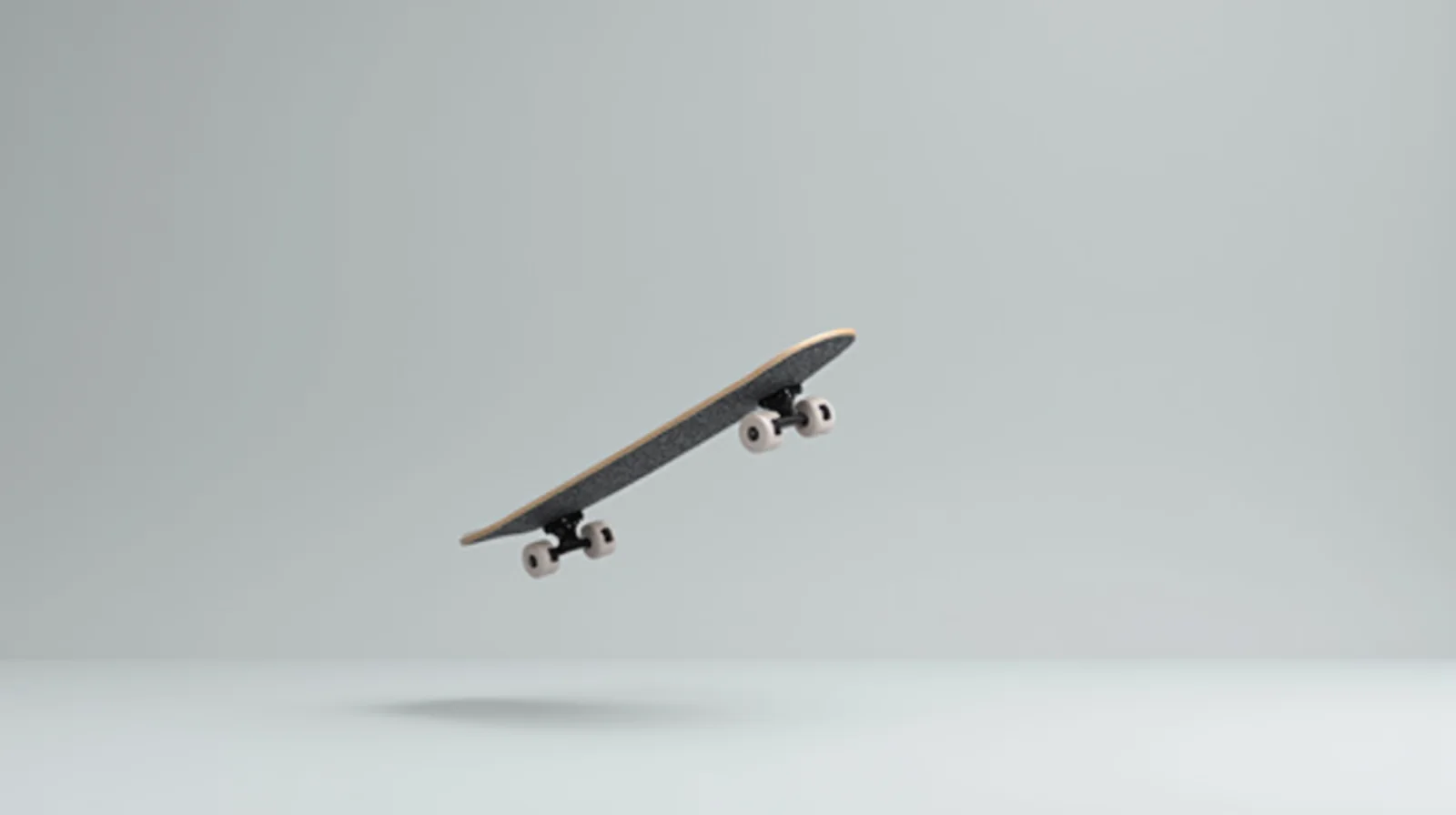
The bigspin is the trick that separates skaters who have outgrown the 360 from the ones still learning to rotate. Pop your board, kick a full 360 degrees of deck rotation with your back foot, and catch it backside — you land facing the same direction you started, but the board has spun a full turn beneath you. Done clean, a bigspin reads as one fluid motion. Done wrong, it lands you on your hip or rolling off the nose. In this guide I break down exactly how to bigspin in 2026: the gear setup that makes rotation easier, the step-by-step body mechanics, the surfaces that build confidence, and a progression plan that takes you from a stuck 270 to a clean, repeatable backside landing.
By Tyler Brooks, Skateboarding Coach
Tyler has coached skateboarders for 10 years and has tested trucks, wheels, and protective gear on real street and park sessions. He leads skill development and safety coverage.
Published: September 24, 2026
What Exactly Is a Bigspin?
A bigspin is a full 360-degree rotation of the skateboard in the air, caught and landed backside. That backside landing is the whole reason it is a distinct trick rather than just a “360.” When you 360 flip or 360 spin and land regular (facing forward, the way you started), the board has returned to its starting orientation and the rotation is almost invisible to the eye. A bigspin, by contrast, lands you on your back foot, facing backward — the board has rotated 360 but your body has not, so you finish in a fakie-facing position relative to your takeoff.
Here is the mental model that makes it click. In a frontside and backside 180, your body rotates with the board. In a 270, you spin a half-turn past the landing and catch it. The bigspin inverts that relationship: the board does the full 360, and your body stays mostly square, only drifting backside to match. Think of it as a 360-degree kickspin (the same rotation you already use to initiate a kickflip) that you complete and hold instead of catching early, then landing backside.
The one-sentence definition
Pop an ollie, kick the nose a full 360 with your back foot, keep your shoulders square, and land backside on your back foot. The board turns; you mostly do not.
Bigspin vs 360 Spin vs Varial: Know the Difference
Skaters mix these three up constantly because they all involve a full turn. The difference is which thing rotates — the board or your body — and where you end up facing. Before you chase the bigspin, make sure you are actually aiming at the right trick, because the body mechanics for each one are different enough that practicing one will not accidentally teach you the other.
After coaching dozens of skaters through this exact confusion, the fastest way to tell them apart is to watch the landing foot and the facing direction. In the table below, “facing” describes which way your chest points when you come down.
| Trick | What rotates | Body rotation | Landing / facing |
|---|---|---|---|
| Bigspin | Board spins 360 | Minimal (stays square) | Back foot, backside |
| 360 Spin (frontside) | Body spins 360 | Full turn with board | Front foot, forward |
| Backside 360 | Body spins 360 | Full turn, opposite dir | Front foot, forward |
| Varial (inside 360 flip) | Board flips 360 | Body drifts frontside | Front foot, forward |
Key: the bigspin is the only one of the four where the board does the full turn and you land backside. If you are landing forward, you are doing a 360 spin or a varial, not a bigspin.
Gear Setup That Makes Rotation Easier
Bigspins are unforgiving of a loose or ill-fitting setup because you are asking the board to complete a full rotation and hold that position in the air. Small wobbles that a clean ollie hides get amplified over a 360-degree arc. From tightening hundreds of boards, these are the settings that consistently make full rotations feel smoother and catch easier.
Truck tightness. Slightly tighter trucks reduce the wobble that creeps into a long rotation. If your board is already loose for cruising, a bigspin will feel like it is fighting you. A touch more tension in the kingpin nut — about a quarter turn from your street setting — steadies the platform. The full rationale for dialing this in is in our skateboard truck buying guide, which covers how truck width and axle length affect pop and control.
Deck size and concave. A deck that is too wide slows your back-foot kick; a deck that is too little concave lets the board slide off your back foot mid-rotation. A 8.0–8.25 inch deck with medium-to-high concave is the sweet spot for most street skaters learning full rotations. We break down the exact width and ply trade-offs in our skateboard deck guide.
Wheel and bearing condition. Clean, well-lubed bearings and grippy wheels matter more here than in any other trick, because you are relying on a smooth, consistent ollie as the launch. A sticky or dry bearing costs you the height and hang time the rotation needs. Our bearing cleaning guide walks through a full teardown and re-lube.
Step-by-Step: How to Bigspin in 2026
Before you attempt this, be honest about your baseline. A bigspin is an advanced trick that assumes a clean, consistent ollie, a solid 270, and the ability to kick a full 360 on a kickflip. If your 270 is still inconsistent, spend a week on that first — the bigspin builds directly on the same back-foot kick. Here is the full sequence, broken into the stages your body actually has to perform.
- Roll in square. Approach at a moderate speed — faster than a 270, slower than a manual. Your shoulders should point straight down the line, not pre-rotated. If you start facing backside, you will not have enough room to kick the full 360.
- Set your feet like a kickflip. Back foot across the tail at a 45-degree angle, toes over the edge; front foot in the middle of the deck, slightly behind the trucks. This is the exact stance you use to pop a kickflip, because the initial kick is identical.
- Pop and slide up. Pop the tail with your back foot and slide it up the deck toward the nose, exactly as you would for a kickflip. The ollie pop gives you the height; the upward slide starts the rotation.
- Kick the nose a full 360. As the board rises, snap your back foot outward and forward to spin the nose. The key difference from a kickflip: do not stop the kick at 180 degrees. Continue the circular motion all the way through, keeping your leg driving the rotation the entire arc. This is the hardest part — your instinct from kickflipping is to catch early, and you must override that.
- Keep your shoulders square and your body tall. As the board completes its turn, resist the urge to spin your upper body with it. Stay tall, arms slightly out for balance, chest facing the same direction you started. Your body does not do a 360; the board does.
- Drift backside to match the landing. In the final moment before you drop, let your hips and back foot rotate a small amount backside so your back foot lines up under the landing. This drift is small — maybe 30 to 45 degrees — not a full turn.
- Land backside on both feet, weight to the back foot. Catch the board with your back foot on the tail and your front foot on the nose, both feet coming down on the same spot. Bias your weight slightly to the back foot so you roll out backside (fakie) rather than pitching nose-first.
- Roll out fakie and absorb. Bend your knees to absorb the impact, then ride away in a fakie-facing stance. If you catch it, the backside roll-out is the confirmation that it was a real bigspin and not a sloppy 270.
The make-or-break moment
Almost every failed bigspin is the same failure: the kick stops at 180 and the board catches as a half-cached flip or a 270. If your bigspins keep landing forward or short, the fix is almost never your landing — it is your kick not completing the full circle. Slow the trick down on flat ground until you feel the nose come back around past the 180 and continue.
Progression Plan: From Stuck 270 to Clean Bigspin
You do not learn a bigspin in one session, and trying to is the fastest way to hurt yourself or build a bad habit. The progression below is the order I have skaters work through, and the time estimates are based on skaters with a solid ollie and 270. Move to the next step only when the current one is clean at least 50 percent of the time on flat ground.
- Flat-ground kickflip to the 360 (weeks 1-2). Practice a kickflip but do not catch it — let the board spin a full 360 and see where it lands. You are training the full-circle kick and the body staying square. This is the single most important drill; it isolates the one skill the bigspin adds on top of a kickflip.
- 270s to build the backside drift (week 2). Do clean backside 270s and focus on the small backside drift of the hips. The bigspin landing uses this exact drift, just with more board rotation underneath.
- Slow bigspins on flat ground (weeks 3-4). Take a short run-up and attempt the full trick at low speed. Expect to catch only the tail or only the nose early on. This phase is about catching both feet, even if the roll-out is ugly.
- Bigspin on a small ledge or box (week 4-5). A 4-inch to 6-inch ledge gives you a defined landing surface and a little more air, which helps the rotation complete. This is where the trick starts to feel like a real trick rather than a flat-ground drill.
- Bigspin in real sessions (week 5+). Once you are catching it on a ledge, take it to a park or street spot. Speed and varied terrain will expose the weak points the flat-ground drills hide.
The 5 Most Common Bigspin Mistakes (and Fixes)
From watching skaters attempt this, the failures cluster into five patterns. If your bigspins keep failing, one of these is almost always the cause. Diagnose before you practice — grinding the wrong fix wastes sessions.
| Mistake | What you see | The fix |
|---|---|---|
| Kick stops at 180 | Board lands as a 270 or half-cached | Do flat-ground 360 kickflips; feel the full circle |
| Body spins with the board | You end up facing forward | Keep shoulders square; only drift hips backside |
| Not enough height | No hang time to complete rotation | Clean up your ollie pop; ensure bearings are lubed |
| Landing off the nose | Pitch forward and wipe out | Drop your hips and bias weight to the back foot |
| Approach too fast or too slow | Inconsistent timing | Find a repeatable medium speed before adding tricks |
Note: the two most frequent errors are the first two — an under-rotated kick and a body that spins with the board. Fix those before anything else.
Best Surfaces to Practice the Bigspin
Where you practice matters as much as how. The right surface gives you consistent feedback; the wrong one teaches you to bail out of the trick instead of finishing it. Here is how I break down the practice order.
Flat, smooth ground first. A smooth concrete pad or an empty parking lot is where you build the rotation and the square-body feel. There is no landing target, so you focus purely on the kick and the body. This is non-negotiable — most skaters skip it and then blame the trick when a ledge exposes the gap.
A 4 to 6 inch ledge next. The ledge gives the board a defined surface to catch on, which makes the landing repeatable. It also adds a fraction of air that helps the full rotation complete. A low box or a clean curb works here. Avoid ledges taller than 8 inches until you are catching the trick cleanly on lower ones.
A bowl or park for the final step. Once the bigspin is clean on ledges, the bowl is where it becomes a real part of your line. The quarter pipe gives you the air and the flow to string the trick into a transition run. If you do not bowl regularly, a street park with varied obstacles is a close substitute.
Safety: How to Fall Out of a Bigspin Without Hurting
A bigspin wipe-out is usually a backside or forward tumble, and the two most common injuries are to the wrist and the hip. You will bail on this trick — the goal is to bail without getting hurt. Two habits from my how to fall safely guide cover almost every bigspin failure.
Tuck your arms, not your hands. The instinct is to put a hand down, and that is how you get a wrist fracture. Instead, fold your arms across your chest and roll with the fall. It looks worse than it is and spares your wrists.
Keep your gear on. A helmet, wrist guards, and elbow and knee pads are not a beginner crutch on this trick — they are standard equipment. A backside slam without a helmet is a concussion risk, and the hip impact on a missed catch is exactly what pads are for. Our essential safety gear guide covers what to actually buy and how to fit it, and our injury prevention guide goes deeper on the mechanics of avoiding the worst outcomes.
Stop if the bail pattern changes
If you start landing on your shoulder or hip repeatedly, that is a signal the trick is not ready — the body is absorbing rotation it should not be. Back off to flat-ground drills for a few sessions rather than grinding through pain.
How Do You Bigspin: FAQ
How is a bigspin different from a 360?
In a bigspin the board does the full 360 rotation and you land backside, while your body stays mostly square. In a 360 spin, your body does the full turn with the board and you land facing forward. Same amount of rotation, completely different body mechanics and landing.
Do you have to land backside?
Yes. Landing backside is what makes it a bigspin. If you land facing forward, you have done a 360 spin or a varial. The backside landing, rolling out fakie, is the defining feature of the trick.
What tricks should I learn before a bigspin?
You need a clean, consistent ollie, a solid backside 270, and a kickflip with enough control to kick a full 360. If any of those are shaky, fix that first. The bigspin is built directly on all three, and the flat-ground 360 kickflip drill is the most important bridge.
Why does my bigspin keep landing forward?
Two causes, in order of likelihood: your kick is stopping at 180 degrees instead of completing the full circle, or your upper body is spinning with the board instead of staying square. Do flat-ground 360 kickflips to train the full-circle kick, and consciously hold your shoulders facing your original direction through the rotation.
How long does it take to learn a bigspin?
For a skater with a solid ollie and 270, expect roughly four to six weeks of focused practice to land it cleanly, following the progression from flat-ground 360 kickflips through slow attempts to ledges. Skaters who skip the flat-ground drills usually take longer because they are solving the rotation and the landing at the same time.
Sources
References and further reading for the mechanics, gear specs, and trick taxonomy used in this guide:
- Indy Trucks — truck geometry, kingpin tension, and how axle length affects pop and control on rotation tricks.
- Wikipedia: Skateboarding trick — standard taxonomy of spin, flip, and board-rotation tricks and the conventions for naming them.
- Wikipedia: Ollie — the foundational pop-and-slide mechanics that every aerial rotation trick is built on.
See Also
Keep learning the spin and rotation family:
- Frontside and Backside 270: Step-by-Step Guide — the direct prerequisite, with the same back-foot kick.
- How to Kickflip: Step-by-Step Guide — the kick mechanics the bigspin extends to a full 360.
- Frontside 180 and Backside 180 — the body-rotation foundation for the whole spin family.
#Bigspin #Skateboarding #SkateTricks #SpinTricks #SkateboardingTricks #HowToBigspin #360Spin #BacksideLanding #SkateSkill #StreetSkating #SkatePark #SkateboardTricks #Kickflip #Skateboarding2026 #LearnToSkate
This guide is part of the ska8 daily series. Explore more below.